In Takayama, the Hida beef was as soft as butter, the autumn colors kept us reaching for our cameras, and my arrows stubbornly refused to fly straight. Inna and I stayed two nights at Oyado Koto No Yume, using the town as our base for a day trip to Shirakawa-go before heading to Hirayu Onsen.
Our favorite old-town street was Kamisannomachi. Between the handmade gifts, snacks, and sake, there was always another reason to stop. The difficult part was leaving enough time for it all.
November 14–16 and our return on November 18 record our experiences. All times are JST.
Saturday, November 14, 2026
Getting here: a busy journey from Nikko
Leaving Nikko
We left Nikko with a boxed breakfast and green tea from our hotel. The breakfast—a small rice-bowl-like meal with fish—was delicious, though not very filling. We chose the 7:18 a.m. local from JR Nikko over the 7:52 train we had considered, giving ourselves more time for the connections ahead.
Busy trains and students on a Saturday
Most seats were taken on the trains to Takayama. Inna’s advance reservations proved their worth, though the local from Nikko to Utsunomiya had unreserved seating. The Wi-Fi was less dependable: frequent dropouts made it hit-or-miss.
What surprised me on the local train was the number of teenagers in school uniforms. It was Saturday, yet they looked as though they were heading to school. We never found out where they were going.
Background: Japanese public schools generally have classes Monday through Friday, although some schools also hold Saturday classes. School sports and cultural clubs can meet on days off, too. The students we saw could have been traveling to classes, club activities, or a school event; their destination and reason for traveling weren’t confirmed. Japan National Tourism Organization: school schedules and clubs.
Food for the journey
I also noticed self-serve food shops in Japanese railway stations where passengers could choose snacks, bento boxes, and sushi to purchase for their journeys.
Background: Station bento meals are known as ekiben, a combination of the words for station and boxed meal, and often feature regional specialties. JNTO: local ekiben culture.
Coffee at a chilly Utsunomiya Station
At chilly Utsunomiya Station, we stopped at Beck’s Coffee Shop inside the Shinkansen gates for a cappuccino each. They cost ¥540 (approximately US$3.38) apiece, or ¥1,080 (approximately US$6.75) for the two of us.
Collecting our tickets and a quick lunch in Toyama
In Toyama, finding the JR West office took some effort. Inna located it and collected our Hida tickets from a machine; a staff member then checked them for us.
We fitted in lunch at Saint Marc Café at Toyama Station: a hot ham-and-cheese sandwich set for ¥980 (approximately US$6.13) and a hot BLT set for ¥1,030 (approximately US$6.44), each including a medium café latte. Two premium almond Choco Cro pastries added ¥680 (approximately US$4.25) for the pair. Lunch wasn’t bad, and ¥2,690 (approximately US$16.81) for both of us made it a fairly inexpensive stop between trains.
Was our itinerary covering too much ground?
The transfers felt hectic and tedious. Inna had put a great deal of preparation into the tickets and seat reservations, and with the trains so full, I was glad she had.
Still, I wondered whether we were covering too much ground. Were we spending too much time on transportation and too little enjoying the places we had come to see? It was a question about our pace, even as I appreciated all the work Inna had done.
Our Takayama stay
After the journey from Nikko, we had two nights in Takayama, November 14–16, at Oyado Koto No Yume, with breakfast included.
Nakabashi Bridge, downtown crafts, and Japanese treats
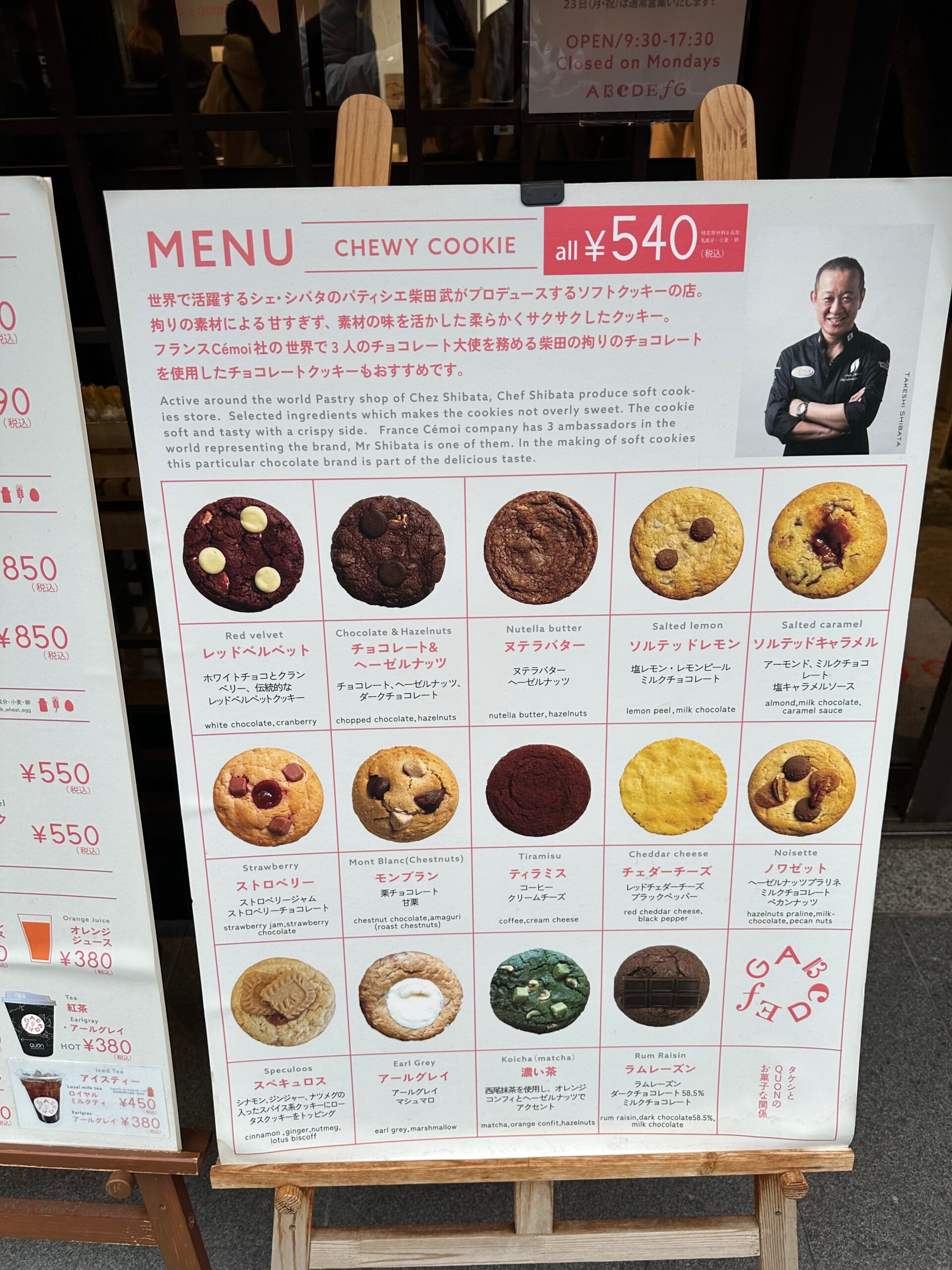
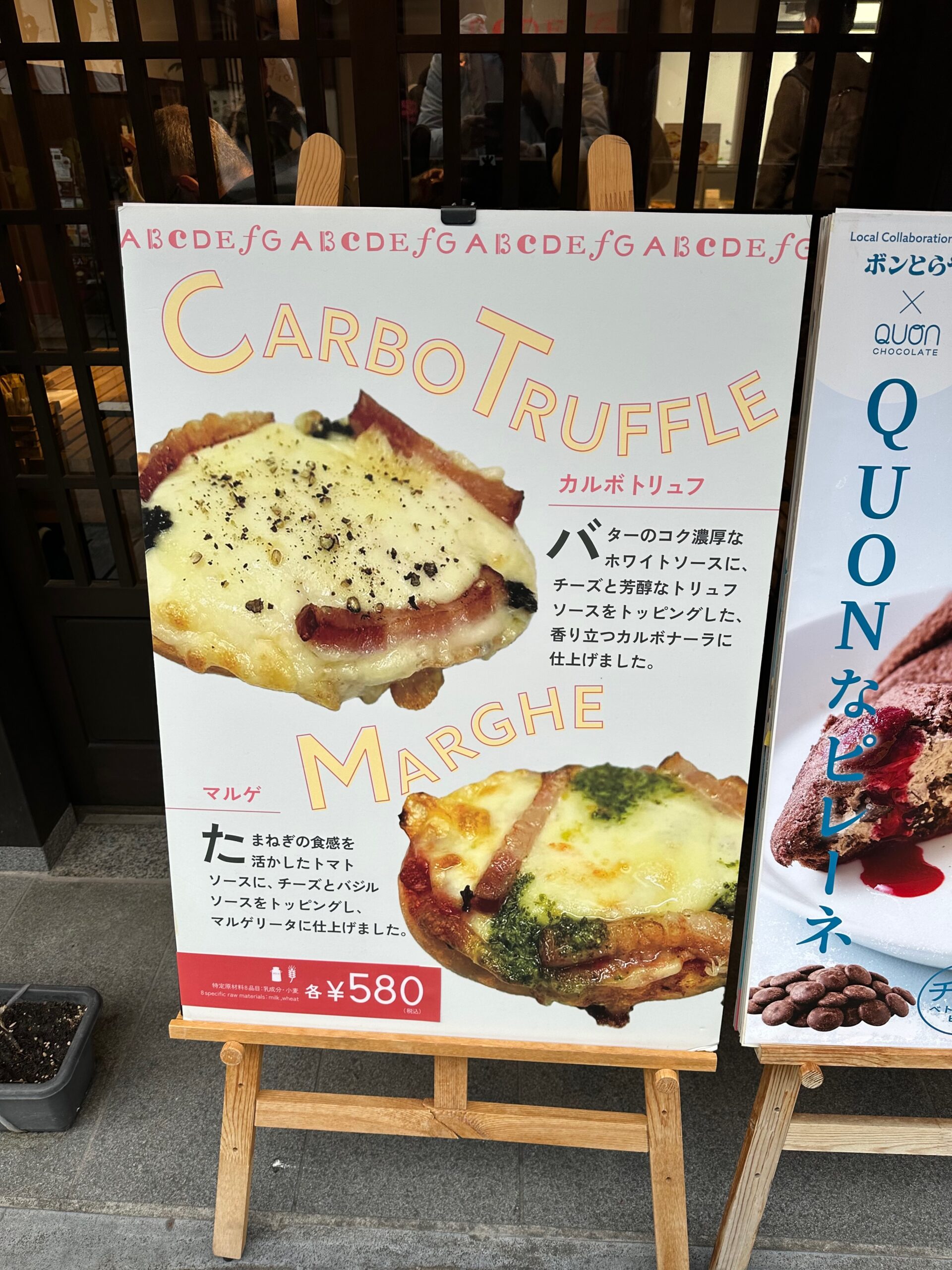
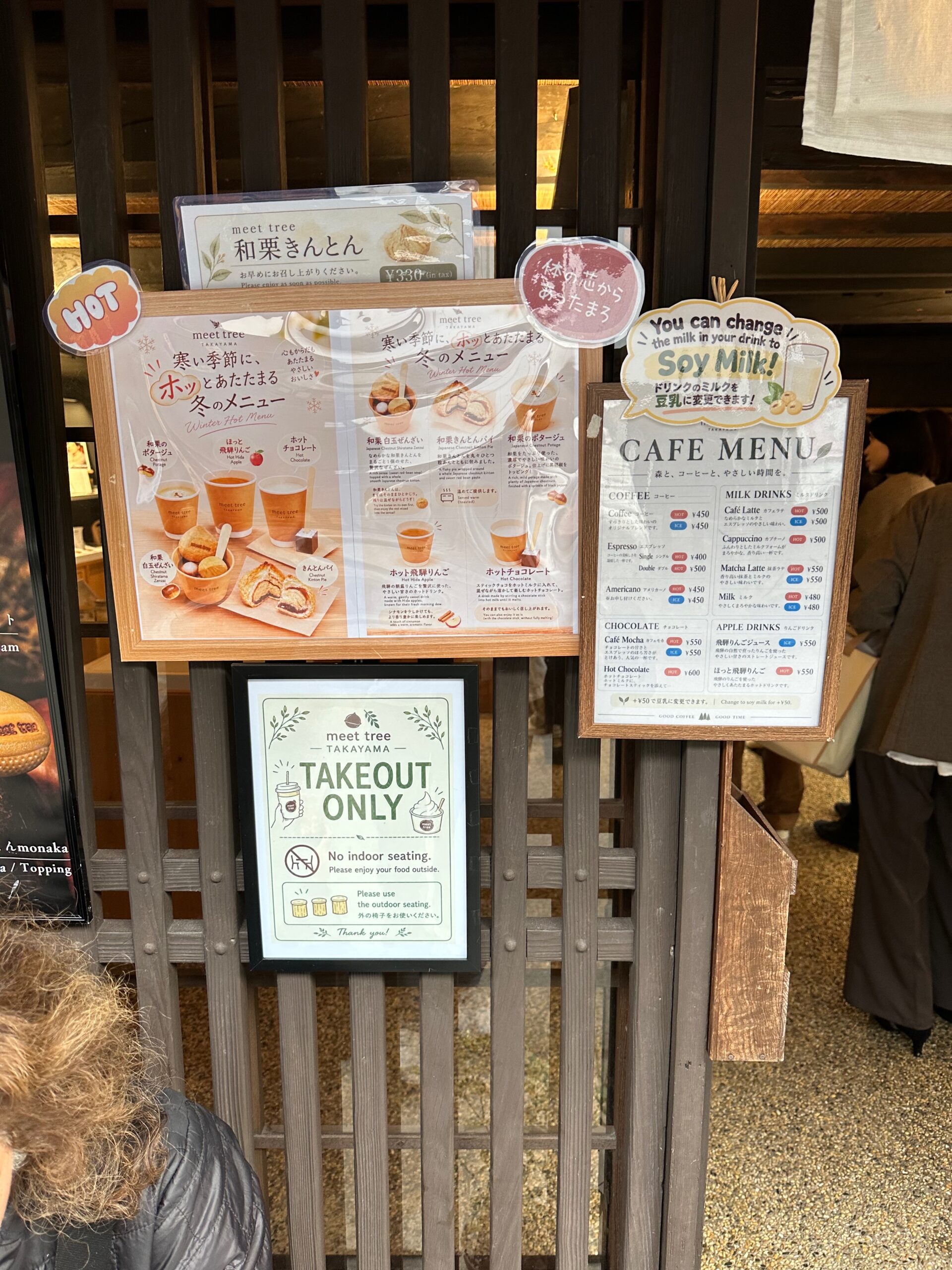
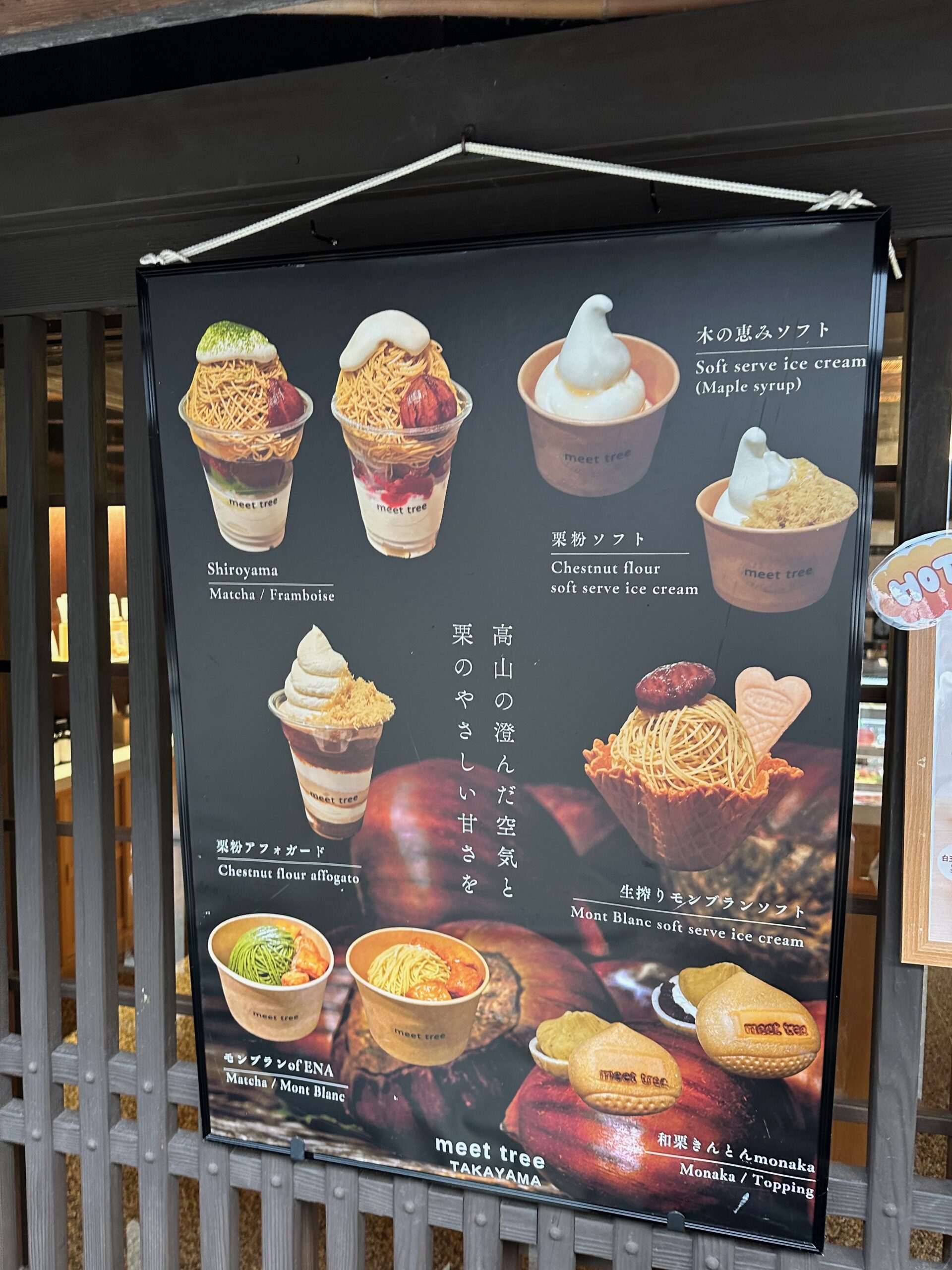
We began with Nakabashi Bridge, then wandered downtown among the arts and crafts. The snacking started with Mont Blanc ice cream at meet tree TAKAYAMA. The chestnut topping looked like fine noodles piled over the ice cream—the first time I had seen ice cream presented that way. We continued with a Carbo Truffle, a soft cookie from ABCDEFG — Takeshi & QUON, Hida Takayama, and a large soy-sauce-flavored Japanese cracker. We also came across Funasaka Sake Brewery, but it was extremely busy. We decided to come back another time—which turned out to be the next day, with our friends.
A cute gift from Sakurada
Browsing with our friends brought us to Sakurada. Its colorful handmade pieces were some of the cutest gifts we found in Takayama—unique, beautiful, and hard to walk past. We bought a gift to take with us.
A few photos from our snack stops
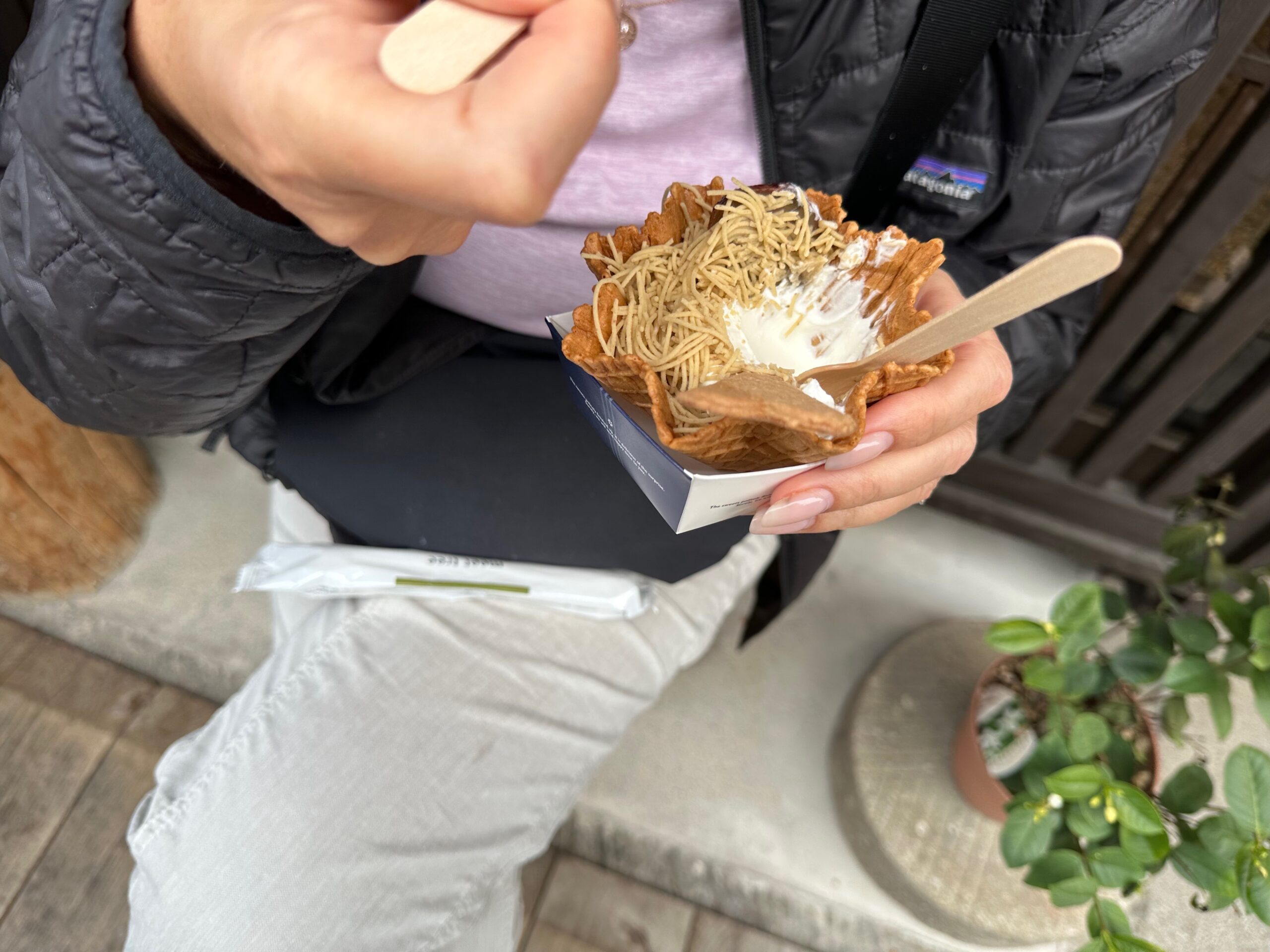
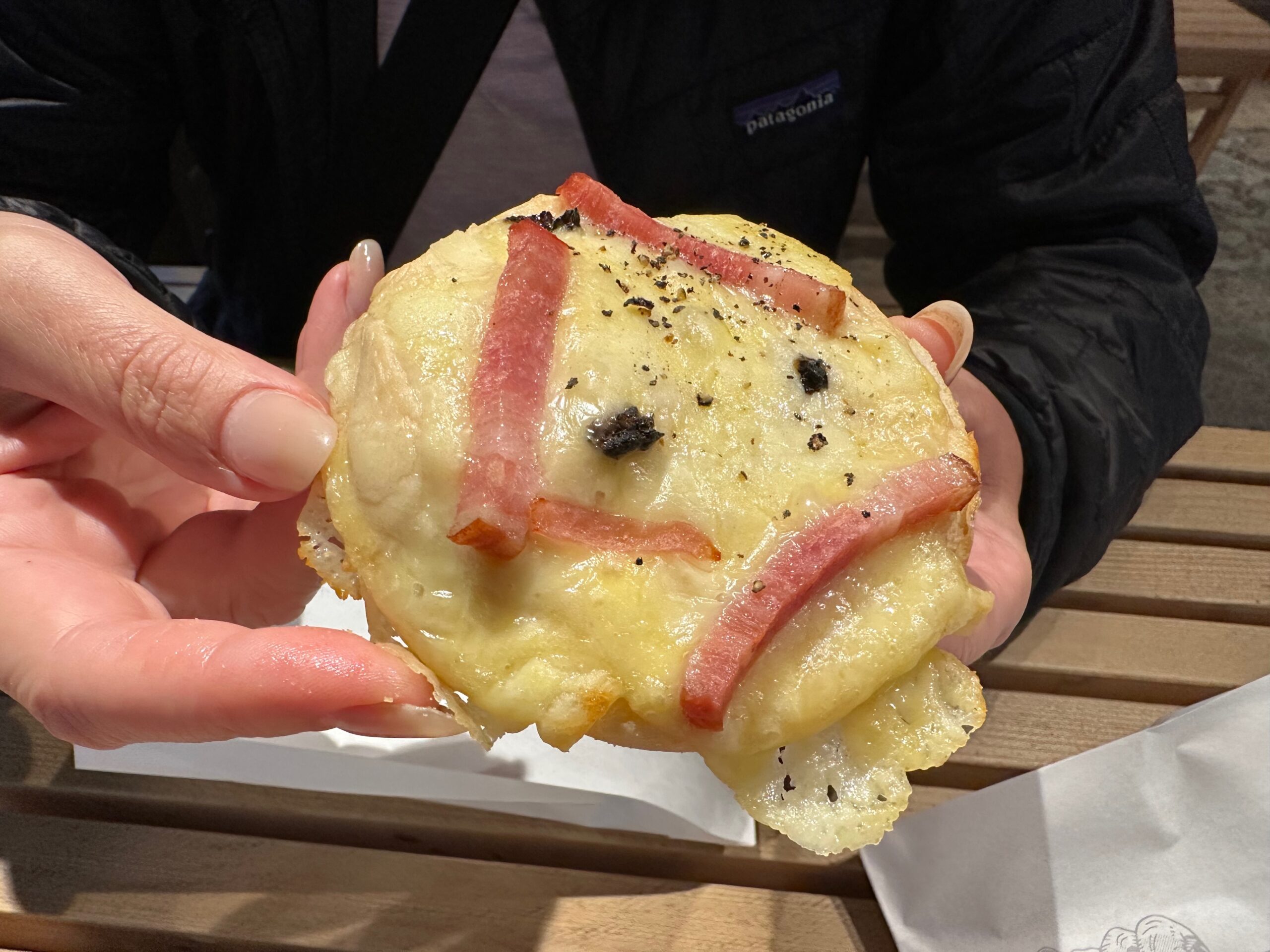
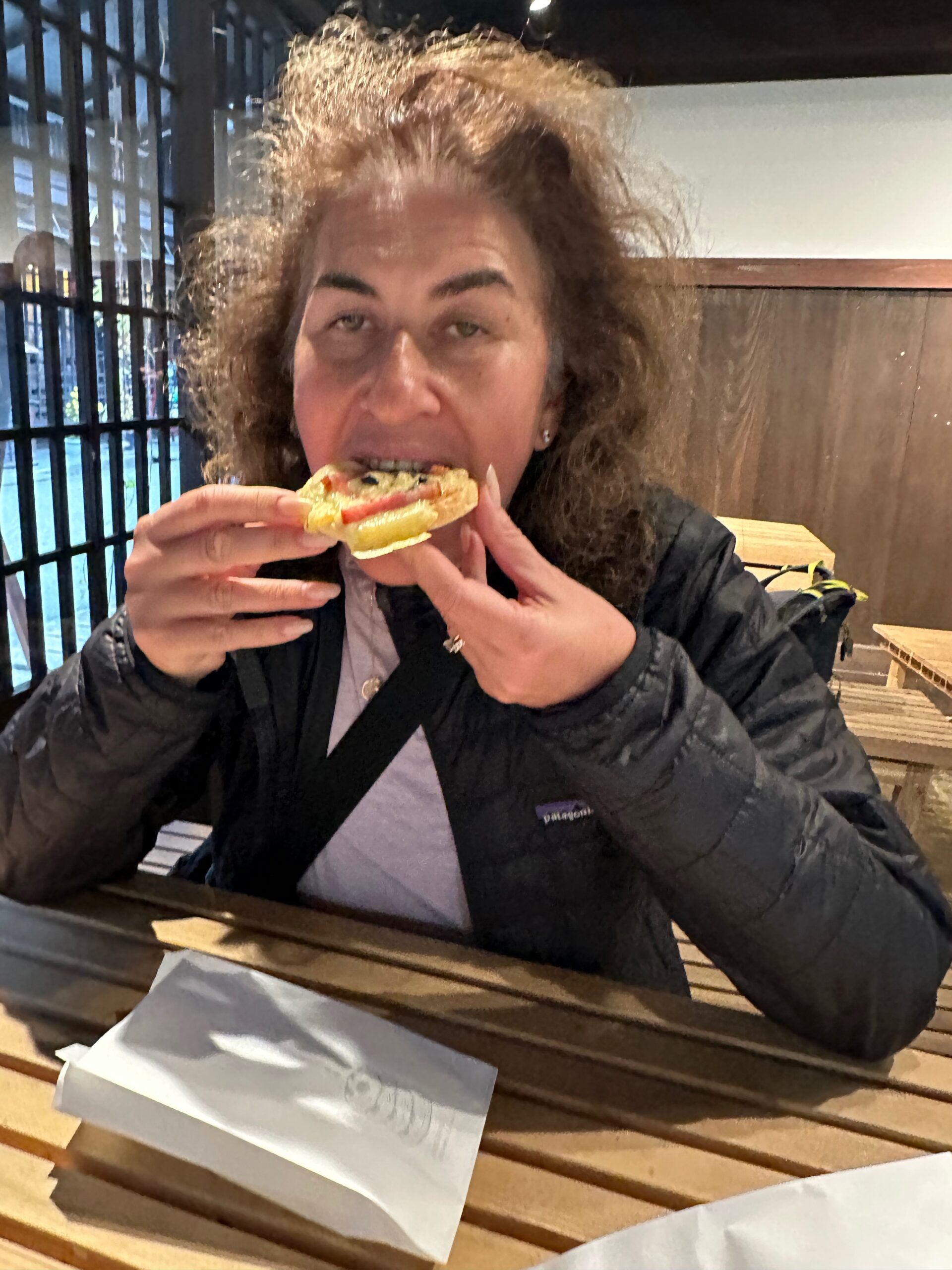
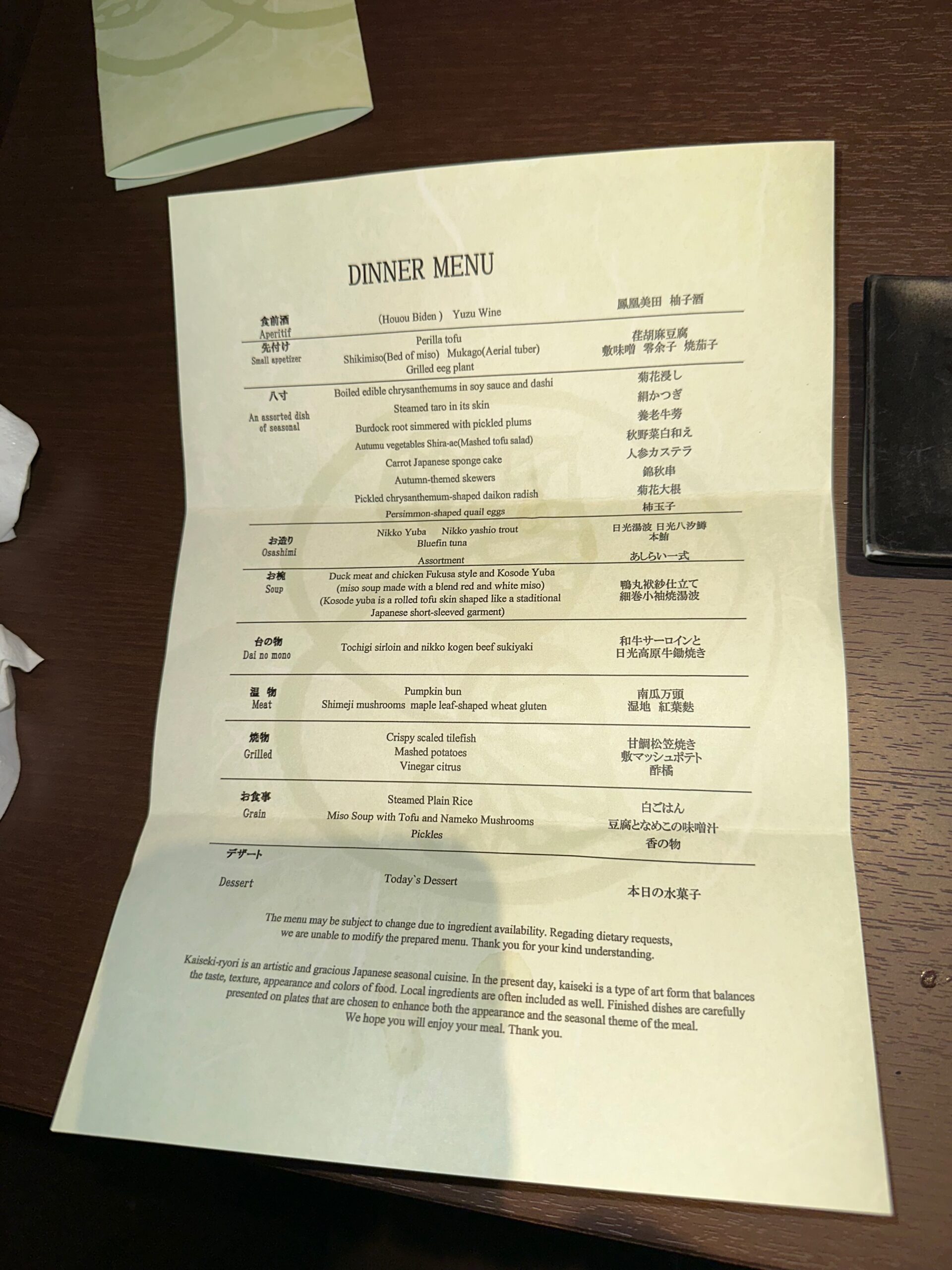
Menus from our Takayama snack stops
Friendly staff, but a room that felt cramped
Oyado Koto No Yume was a very nice hotel, with excellent, friendly staff. Many of the people we met on the team came from abroad, including a woman from Nepal and a man from Switzerland.
Our room, though, was quite small. We were not used to one room doing duty as both living room and bedroom. During the day, a table stood in the center, and we sat on the tatami mats rather than chairs. In the evening, the table was moved aside to make room for the futon bedding. It all felt a bit cramped.
I also missed having a private shower. The room had a bathroom, but I had to go to the public bathing facilities for my morning showers. I adjusted quickly, though it would not have been my first choice. For us, this kind of room was adequate for a night or two, but would not work well for a longer stay.
November 14 train times, seats, and fares
- We boarded the unreserved JR Nikko Line local at JR Nikko at 7:18 a.m. The timetable arrival at Utsunomiya was 8:06 a.m., giving a scheduled 60-minute connection before Yamabiko 208. JR Nikko is separate from Tobu-Nikko, where we arrived the day before.
- Booked JR East Tōhoku Shinkansen Yamabiko 208: Utsunomiya 9:06 a.m. → Ōmiya 9:34 a.m.; car 6, seats 10D (Inna) and 10E (Boris). Confirmation total for two adults: ¥7,220 (approximately US$45.12). The earlier local gave a scheduled 60-minute connection at Utsunomiya.
- Booked Hokuriku Shinkansen Hakutaka 557: Ōmiya 9:57 a.m. → Toyama 12:04 p.m.; car 9, seats 12A (Inna) and 12B (Boris). Confirmation total for two adults: ¥24,880 (approximately US$155.50). The Ōmiya connection is 23 minutes.
- Booked JR limited express Hida 14: Toyama 1:08 p.m. → Takayama 2:39 p.m.; ordinary reserved, non-smoking car 8, seats 8A and 8B. Total ¥7,240 (approximately US$45.25) for two adults, including the basic fare. The Toyama connection is 64 minutes.
- Our two Shinkansen reservations used each traveler’s designated Suica / e-ticket arrangement. At Toyama, Inna collected the Hida paper tickets from a ticket machine, and a JR West staff member checked them for us.
Rainy-day alternatives we considered
Before arriving, we had considered Takayama Jinya, Showa-kan Museum, and the Festival Floats Exhibition Hall as alternatives if rain made outdoor sightseeing unpleasant. We later visited the floats hall on November 16.
Dinner at Shintei Nakagawa
For dinner, the hotel reserved a 7:00 p.m. table at Shintei Nakagawa, known for Hida beef. The twelve-minute walk took us along mostly deserted streets, with only a few shops and restaurants still open.
I chose Hida beef stew with salad and rice, plus a glass of Pinot Noir. Inna ordered a 150-gram Hida beef filet steak with salad and rice, followed by apple pie. We both loved the beef: soft and smooth as butter. Even the salad stood out, beautifully presented and delicious.
Ten arrows and a stubborn drift to the right
After dinner, we stopped at Hankyu Dojo to try hankyū (半弓), a recreational form of Japanese short-bow archery. It made for a fun change of pace after dinner!
The dojo explains that you shoot seated with a smaller bow, aiming at a target about seven meters away. A round consists of ten arrows, with points depending on where they land. It is approachable for beginners, though getting the arrows to go exactly where you want is another matter!
Inna and I each shot ten arrows. My round cost ¥400 (approximately US$2.50); the beginner option with extra instruction was ¥800 (approximately US$5). I managed to hit the target, but my arrows kept drifting right. Pointing at the bullseye, it turned out, was only the beginning.
A relaxed evening back at the hotel
The evening ended more quietly. Inna had hot herbal tea and tried origami, while I sampled the hotel’s complimentary plum wine—delicious. Other travelers were chatting nearby, and I heard plenty of French.
Japan so far: so much to enjoy
For the most part, Japan has been excellent. The food, thoughtful hospitality, beautiful sights, and little discoveries along the way have given us so much to enjoy. There have been a few hiccups with pre-booking train tickets and navigating websites—some seemed to work only during Japanese business hours—but those frustrations are a small part of the trip. Even with my questions about how much ground we are covering, there has been far more to love than to complain about.
Sunday, November 15, 2026
A rainy-day visit to Shirakawa-go
A 7:20 a.m. bus meant a 6:00 start at Oyado Koto No Yume. I went downstairs to the public bath to shower, shave, and spend a few minutes in the onsen. Another gentleman was there at first; after he left, I had it to myself.
Inna was getting ready when I returned. At 6:50 a.m., we took the elevator to the second floor for breakfast, kindly served ten minutes early so we could catch our bus. Mine was Japanese: rice, miso soup, meat, pickled vegetables, and a raw egg for dipping the meat. Inna chose the Western breakfast with eggs.
After breakfast, we hurried to the bus station, about five minutes away. Our bus was waiting at bay 4, where a long line had already formed. With assigned seats, 2A and 2B, we were not worried about finding a place. The ride was uneventful, apart from our concern about the light rain. We reached Shirakawa-go at 8:10 a.m. and took out our umbrellas.
We explored the village’s colorful foliage and thatched houses, visited the Ogimachi Castle Observation Deck and Wada House, enjoyed coffee and cake at Hanamizuki, and had an excellent lunch at Gassho Teahouse Magoemon. The full village account was recorded in our Shirakawa-go entry.
An early return to Takayama
We returned earlier than planned, buying new tickets for the 1:15 p.m. bus instead of using our original 5:25 p.m. booking. By 2:10, we were back in Takayama with time to meet our friends and enjoy another afternoon in town.
A stop at June Coffee
Before meeting our friends, we stopped at June Coffee for two cappuccinos and a small bagel sandwich to share.
Nakabashi Bridge, cookies and sake tasting
After finishing our coffees, we walked to Nakabashi Bridge and then browsed the old-town shops. We stopped at the ABCDEFG — Takeshi & QUON, Hida Takayama for a few cookies. I tried the matcha flavor and really liked it.
This time, we made room for sake tasting at Funasaka Sake Brewery. Armed with ten tasting coins, we sampled several drinks. Numbers 34 and 46 were among our favorites, along with the yuzu liqueur and plum wine.
Background: Funasaka Shuzouten is a working brewery with about 200 years of history in Takayama's old town. It makes sake using spring water from the Hida mountains and sake rice, with traditional brewing methods. Its sake brands include Miyamagiku and Yotsuboshi. The premises combine brewing, a shop, tasting facilities and a restaurant. The brewery's coin-operated tasting system lets visitors compare small servings; the numbered drinks correspond to numbers used on its shop shelves, making favorites easier to find afterward.
Archery with friends and an evening gyoza stop
At Hankyujo Takayama, I was already on my second archery visit; our friends were trying it for the first time. We had fun shooting together.
Afterward, we followed well-lit Honmachi Dori to Gyoza Oh for a few gyoza. They took nine minutes to prepare, but were quite delicious.
Dinner at Matsuki Sushi
The hotel had helped us book Matsuki Sushi for 7:15 p.m. We arrived a little early and ordered the Daimyo Sushi Roll. Its eight pieces were huge—enough for Inna and me to share. The roll was delicious, and we thought the restaurant excellent. Bring cash: it did not accept credit cards.
Monday, November 16, 2026
A morning shower, onsen, and breakfast
I woke at 6:45 a.m., brushed my teeth, and went downstairs for a shower and a few minutes in the men’s public onsen at Oyado Koto No Yume. It was a lovely way to start the day. Back in our room, I packed the remaining items before breakfast.
At 7:30 a.m., Inna and I took the elevator downstairs. We had requested breakfast for that time, and everything was already prepared at a table marked with our room number. Other couples were already eating, and more continued to arrive after us.
I started with some plain yogurt, but the rest of my breakfast was Japanese style: beef, rice, miso soup, pickled vegetables, and a fruit plate. Inna enjoyed her Western breakfast of eggs, though the pastries did not look very appetizing to her, so she skipped them.
After breakfast, we brought our luggage downstairs, asked the hotel to store it, and checked out. Then we set off for the Miyagawa Morning Market in the old town, with more of Takayama still to enjoy.
A beautiful discovery: Hida Kokubun-ji
On our way to the market, we stumbled upon Hida Kokubun-ji Temple. The autumn foliage stopped us in our tracks, and out came the cameras. It was a beautiful discovery we had not set out to find.
Temple background: Founded around 746, Hida Kokubun-ji was part of Emperor Shōmu’s network of provincial Buddhist temples, established to pray for the country’s protection. Its surviving main hall dates from the Muromachi period, while the three-story pagoda was rebuilt in 1821. The temple is also known for its enormous ancient ginkgo tree. These layers of history make it one of Takayama’s most significant Buddhist sites. Temple history.
Croissants, coffee, and taiyaki at the morning market
We crossed the bridge toward the old town and joined the vendors and tourists at the Miyagawa Morning Market. Breakfast had not put an end to our appetite for pastries: at Andersen, we tried freshly baked chocolate and anko croissants, with two cups of coffee from Miyagawa Asaichi Coffee Shop (宮川朝市コーヒー屋), right next door.
Andersen specializes in croissants with crisp, flaky layers, and the local tourism guide lists chocolate and anko among its variations. Anko is sweet red-bean paste: a traditional Japanese filling paired here with buttery croissant pastry. It is a lovely example of a familiar pastry taking on a Japanese character. Local guide to Andersen.
Next came fish-shaped pastries with custard, chocolate, and red-bean fillings. We really liked these taiyaki. Despite their sea-bream shape, the filling is sweet; the traditional version contains anko, or sweet red-bean paste. More about taiyaki.
Inna found a handmade Japanese hat and decided to wear it right away. It was chilly outside, so her new purchase came in handy.
Towering festival floats
At the Takayama Matsuri Yatai Kaikan—the Festival Floats Exhibition Hall—the floats towered behind glass, covered in intricate hand-carving. I kept wondering how anything so tall managed not to topple over.
The hall displays a rotating selection of the actual floats used in Takayama’s autumn festival, preserving the work of Hida’s skilled craftspeople. The festival takes place on October 9 and 10 and is associated with Sakurayama Hachimangū Shrine. Official autumn festival guide.
We took lots of photos, listened to the audio guide, and watched a short film showing the October parade. One frustration was a loud visiting tour group: at times, I could barely hear my audio guide. Another group nearby was much quieter, and we wished everyone had shown the same consideration.
Extraordinary colors at Sakurayama Hachimangū
Nearby Sakurayama Hachimangū Shrine gave us another reason to keep the cameras out. Red, yellow, orange, and all the shades between filled the grounds. A few more steps brought another view worth photographing. We had never seen autumn colors like these anywhere.
Shrine background: This Shinto sanctuary honors Emperor Ōjin, worshipped as Hachiman. Enlarged in 1683 under the patronage of the Kanamori lord, it became a shrine for the town’s protection. Its annual autumn festival brings the elaborate floats into Takayama’s streets, linking the quiet shrine grounds with one of the city’s great celebrations. Shrine history.
We texted our friends to tell them they should come and see it. As we were leaving, we happened to run into them nearby!
Two more temples before lunch
After Sakurayama Hachimangū, we continued toward the larger group of temples, beginning with Unryū-ji and Daiō-ji. We walked around and took a few photos before deciding it was time to head back to the old town for lunch.
Temple background: Unryū-ji has close ties to the Kanamori family, Takayama’s former rulers; its bell-tower gate is associated with a building transferred from Takayama Castle. Daiō-ji became a Jōdo Buddhist temple after being moved to its present site under the Kanamori. Its distinctive two-story gate is one of the notable structures of Takayama’s Higashiyama temple district. Unryū-ji history; Daiō-ji history.
Excellent Hida beef bowls at Sakaguchiya
We had read favorable reviews of Sakaguchiya and decided to give it a try. With the old town so crowded, I worried we would face a long wait. Happily, I was wrong: we were seated quickly. Ordering was entirely online, so we used our iPhones to choose our dishes.
We ordered two Hida beef steak bowls, one regular and one large, with the meat cooked medium, plus a Mitsuya Cider. Lunch came to ¥6,350 (approximately US$39.69) for the two of us, including tax.
The beef bowls were excellent. The cider, though, caught me out: I had expected apple cider and got something closer to 7Up. Mitsuya Cider is a Japanese carbonated soft drink. The name had led me astray.
Cappuccinos, pudding, and one last ATM stop
After lunch, we headed toward a Seven Bank ATM to withdraw more yen before leaving for Hirayu. Along the way, we stopped at June Coffee for cappuccinos and a pudding. Around 1:00 p.m., we hurried to the ATM, where I withdrew the money we needed. Then we returned to Oyado Koto No Yume to collect our luggage.
The bus from Takayama to Hirayu
With our luggage collected, we walked to the nearby Takayama Nōhi Bus Center and bought tickets for Hirayu. We waited at platform 5 for the 1:40 p.m. departure. The bus arrived at 1:25 p.m., and a long line formed to board. Fortunately, there was enough room for us. About an hour later, we stepped off in Hirayu.
We contacted Miyama Ouan, and the hotel picked us up within about five minutes. After a busy morning, it was good to have that final transfer work so smoothly.
Our check-in and afternoon bath were recorded in our Hirayu Onsen entry.
November 18: onward travel plans
Wednesday, November 18, 2026
Leaving Hirayu early gave us one more morning in Takayama—and breakfast that did not come with another hotel set menu. We skipped breakfast, checked out of Miyama Ouan and walked to the bus terminal. Our bus left at 7:30 a.m., earlier than the 7:45 a.m. shown on the schedule we had.
Bags in a locker, breakfast on our minds
We reached Takayama at 8:20 a.m. and found a large luggage locker for ¥900 (approximately US$5.63). Getting the right coins took a little work: I first changed a ¥10,000 note at a nearby café, then used the change machine to get nine ¥100 coins. With our bags finally stored, we checked the station departure board: our 11:35 a.m. train to Nagoya would leave from platform 1. After a restroom stop, we headed downtown.
Classical music and hot sandwiches at Don’s
A ten-minute walk brought us to Coffee Don, the highly rated café we had picked near the river. We settled inside with classical music playing in the background and chose hot sandwiches and cappuccinos from the English menu. They took about half an hour to arrive, but they were delicious—a welcome change from our hotel breakfasts.
A second breakfast at the morning market
After breakfast, we strolled to the downtown morning market, which was still going at about 9:50 a.m. We soon found ourselves sampling a few more things. Inna really liked the takoyaki, little batter balls with pieces of octopus inside. My espresso came in an edible cookie cup glazed with sugar on the inside. The coffee and cup were quite good, and I could eat the cup afterward! We also tried tamaten, a marshmallow-like Japanese square. Inna really liked it; I was less enthusiastic.
The river gave us another reason to linger: we spotted a large white egret and a night heron. Inna found a way to get closer for photographs before we headed back to the station.
On time to Nagoya, then a fast ride to Kyoto
We walked back to the station and boarded our 11:35 a.m. train to Nagoya. It left right on time and was about half-full. After a short transfer at Nagoya, we changed to the Shinkansen: Nozomi 259, departing at 2:41 p.m. and arriving in Kyoto at 3:15 p.m. We were in car 4, seats 5D and 5E.
We bought two bento boxes to eat on the Shinkansen. They were okay and did not need heating. The train was very fast! Train Wi-Fi was hit or miss: sometimes it worked well, and other times it did not.
Our booked train details and fares
- Booked JR Central limited express Hida 8: Takayama 11:35 a.m. → Nagoya 2:04 p.m.; ordinary reserved, non-smoking car 2, seats 8A and 8B. Total ¥12,280 (approximately US$76.75) for two adults, including basic fare. Carry the collected paper tickets.
- Booked JR Central Tōkaidō Shinkansen Nozomi 259: Nagoya 2:41 p.m. → Kyoto 3:15 p.m.; car 4, seats 5D (Inna) and 5E (Boris). Total ¥11,420 (approximately US$71.38) for two adults, reserved through SmartEX.
- Transfer buffer at Nagoya: 37 minutes. Follow the Shinkansen transfer-gate instructions for the actual paper ticket and each traveler’s designated Suica, and collect the seat-information slip. From Kyoto Station, our plan was to continue to Ace Hotel Kyoto by local transport or taxi; that final transfer is not separately booked.
What our luggage locker actually cost
Our large locker cost ¥900 (approximately US$5.63), paid with nine ¥100 coins. This was our actual November 18 price; the ¥700 large-locker figure we had found in an earlier visitor guide did not match the locker we used. Station and luggage-storage guide.
Details to add later
- The names of the taiyaki seller and handmade-hat vendor at the morning market, if available.
- Photographs and whether we had enough time in Takayama itself.
US-dollar equivalents are approximate, using the trip’s rounded reference rate of ¥160 to US$1; they are not actual card or ATM exchange rates.
Links
- Coffee Don — official Takayama visitor listing
- Takayama Station — lockers and luggage storage
- ABCDEFG — Takeshi & QUON, Hida Takayama — soft cookies
- meet tree TAKAYAMA — our Mont Blanc ice cream stop
- Miyagawa Asaichi Coffee Shop (宮川朝市コーヒー屋) — coffee next to Andersen
- Oyado Koto No Yume — our ryokan
- Funasaka Sake Brewery — tasting in the old town
- June Coffee
- Matsuki Sushi
- Hida Kokubun-ji — temple history
- Andersen and Miyagawa Morning Market — local food guide
- Takayama Festival Floats Exhibition Hall
- Sakurayama Hachimangū — shrine and festival
- Sakurada — handmade gifts
- Shintei Nakagawa — restaurant listing
- Hankyu Dojo — Japanese short-bow archery
- Sakaguchiya — Hida beef bowls