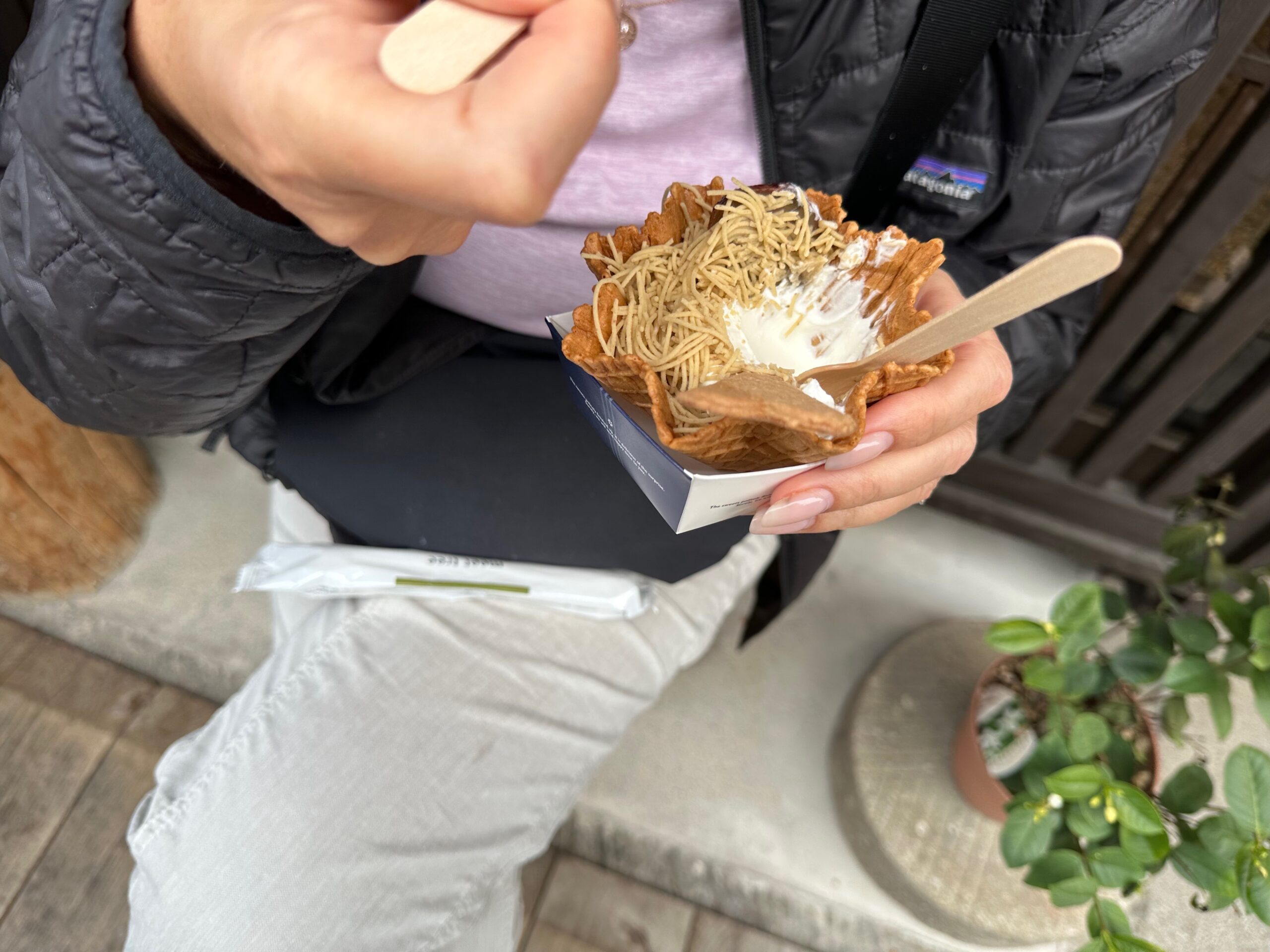
Gold-leaf shrines, spectacular autumn leaves, and a private outdoor bath: our one night in Nikko packed in a lot. Inna and I spent the afternoon exploring before settling into Okunoin Hotel Tokugawa for an elaborate dinner. The challenge was fitting it all in before the sights—and the street-food stalls—closed for the day.
Friday, November 13, 2026
Arriving in Nikko
After an uneventful 105-minute train ride from Tokyo, we stepped off in Nikko at 10:45 a.m. A restroom stop and a taxi ride later, we were at Okunoin Hotel Tokugawa by about 11:00. Our room would have to wait; the sightseeing would not.
We left our luggage at the hotel, and I took out my Canon R8 and swapped my coat for a lighter one. The sun was out, and temperatures were in the high 60s Fahrenheit, around 20°C. We ordered another taxi to Tōshō-gū Shrine.
Tōshō-gū: gold leaf and intricate carvings
We reached the shrine around 11:45 a.m.; the taxi cost ¥2,000 (approximately US$13). Five ticket machines helped keep the short admission line moving. Tickets were ¥1,650 each (approximately US$10), and soon we were inside.
Gold leaf and intricate wooden carvings seemed to compete for our attention. We spent about 90 minutes exploring the buildings, with more detail to take in at every turn. Tōshō-gū honors Tokugawa Ieyasu, founder of the Tokugawa shogunate, and its lavish decoration made it the highlight of our visit.
The carved baku
Among the carvings we found were baku, mythical creatures with an elephant-like appearance. In Japanese folklore, a baku is said to devour nightmares, making it a reassuring protective figure despite its unusual looks. These dream-eating creatures belong to the rich collection of auspicious animals and imaginary beasts decorating Nikko's religious buildings. Japanese government background on Tōshō-gū's baku carvings
Tōshō-gū: history, carvings, and buildings
Background: a sanctuary for the first Tokugawa shogun
Tōshō-gū honors Tokugawa Ieyasu, founder of the Tokugawa shogunate. Established in 1617, it acquired its lavish form through the rebuilding commissioned by his grandson Iemitsu in 1636. The decoration expressed the family's authority and aspirations for lasting peace. Its famous Yōmeimon Gate has more than 500 carvings, ranging from legendary creatures to human figures: an extraordinary concentration of craftsmanship. Japanese government background on Yōmeimon
The entrance, pagoda, and outer courtyard
The five-story pagoda near the entrance was rebuilt in 1818. Its five levels have a religious meaning: from bottom to top, they represent earth, water, fire, wind, and void, the five elements of existence in Buddhist cosmology. “Void” here can be understood as space. The rising tiers give architectural form to this traditional picture of the universe. The pagoda is also a striking example of the Buddhist elements preserved within this Shinto shrine complex. Japan National Tourism Organization's explanation of the five levels
The Omotemon entrance gate has two fierce guardian figures, known as Niō, the muscular Buddhist protectors also found at temple entrances. Their threatening expressions convey their role in defending sacred ground and warding off evil. Beyond it, the Sanjinko, or three sacred storehouses, hold ceremonial equipment and clothing; the upper storehouse is famous for its unusual elephant carvings. The sacred stable, Shinkyūsha, carries the monkey panels, including the familiar “hear no evil, speak no evil, see no evil” trio. These images form part of a sequence about the course of life.
The Omizuya pavilion shelters a purification basin, while the bell and drum towers serve ceremonial roles. Beyond Yōmeimon, the Shinyōsha houses portable shrines used in festival processions. The richly carved Karamon is a ceremonial gateway before the principal sanctuary. Together these buildings show how even practical structures became elaborate works of art. Nikko tourism guide to the buildings
The sanctuary, sleeping cat, and inner mausoleum
The principal sanctuary links the haiden, or worship hall, with the honden, the sacred main hall. Tōshō-gū combines Shinto and Buddhist features, reflecting the close relationship between the two traditions before their official separation in the nineteenth century. Nearby Honjidō is known for its ceiling painting of the “Crying Dragon,” whose name refers to the ringing acoustics produced beneath it.
The small Nemurineko, or sleeping-cat carving, sits above the Sakashitamon gateway. Beyond it, steps climb through the woods to Ieyasu's inner mausoleum, a comparatively restrained resting place after the ornament of the lower precincts. Guide to the sanctuary and inner mausoleum
A quick lunch, Shinkyō Bridge, and an ATM stop
By 1:30 p.m., we were ready for lunch but reluctant to spend much of the afternoon in a restaurant. Two street-vendor skewers—one beef, one tongue—were our quick solution. I had the beef: delicious, and ¥1,000 (approximately US$6).
Our next stop was less scenic but necessary: an ATM. I had not expected so many attractions and train journeys to require cash, and my yen were running low. On the way, we paused for photos of Shinkyō Bridge. With cash replenished, we headed back toward Taiyū-in Mausoleum.
Shinkyō is the vermilion sacred bridge across the Daiya River at the entrance to Nikko's sanctuary. It belongs to Futarasan Shrine. According to the local founding legend, two snakes formed a bridge to help the monk Shōdō cross the river after he appealed to the mountain deities. Official bridge background
Taiyū-in Mausoleum in the fall colors
The 3:15 p.m. admission cutoff kept us moving uphill to Taiyū-in. We bought our tickets and explored a complex that felt less crowded than Tōshō-gū, with amazing fall colors all around. This Buddhist mausoleum belongs to Rinnō-ji and houses the resting place of Ieyasu’s grandson, Tokugawa Iemitsu.
Taiyū-in: history, gates, and guardian figures
Background: Iemitsu's Buddhist mausoleum
Rinnō-ji encompasses several Buddhist sites around Nikko. Its separate Sanbutsudō, or Hall of Three Buddhas, contains images of Amida, Thousand-Armed Kannon, and Horse-Headed Kannon, associated with Nikko's three sacred mountains. That hall was on our original sightseeing list; today's account records our visit to Taiyū-in. Temple background on Sanbutsudō
Taiyū-in is part of Rinnō-ji, a Buddhist temple complex, and is the resting place of Tokugawa Iemitsu, the third Tokugawa shogun and Ieyasu's grandson. Completed in 1653, its buildings combine fine carving, lacquer, and gilding. The connected central halls are designated a National Treasure. Nikko City's architectural history
Its black-and-gold palette was deliberately more subdued than Tōshō-gū's white and gold, expressing Iemitsu's respect for his grandfather. The lanterns donated by feudal lords also conveyed political loyalty; those from the imperial family signaled the relationship between court and shogunate. The succession of guardian gates makes the approach unusually elaborate, even among Japanese religious sites. Rinnō-ji's history of Taiyū-in
Niōmon and the purification pavilion
Niōmon is the first guardian gate, defended by a pair of Niō, also called Kongō Rikishi, or vajra-wielding protectors. Their bulging muscles and fierce faces express the strength needed to keep evil away from the sanctuary. At Taiyū-in, the figure on the right is Mishaku, with his mouth open; on the left is Naraen, with his mouth closed. The poses are commonly called Agyō and Ungyō, suggesting the sounds “a” and “un”: beginning and ending, together conveying completeness. Temple guide to Niōmon The Omizuya purification pavilion was donated by Lord Nabeshima Katsushige. A dragon painted by Kanō Yasunobu decorates its ceiling; its reflection in the basin is known as the “Dragon Reflected in the Water-Mirror.” Temple guide to the fountain
Nitenmon, the drum tower, and the bell tower
Nitenmon, the Gate of the Heavenly Kings, is the largest gate in the Nikko-zan temple complex. Its front is guarded by two of the Four Heavenly Kings, Buddhist protectors associated with the cardinal directions. Green-skinned Jikokuten stands on the left and guards the east; red-skinned Zōchōten stands on the right and guards the south. Behind them are Fūjin, the wind deity, and Raijin, the thunder deity. Its Taiyū-in inscription was written by Emperor Go-Mizunoo. Temple guide to Nitenmon
Farther along, the drum tower stands to the left and the bell tower to the right. Their instruments date to 1653 and are associated with ceremonial timekeeping and important memorial services. Their restrained ornament also reflects Iemitsu's deference to Ieyasu. Temple guide to the towers
Yashamon and Karamon
Yashamon shelters four brightly colored guardian figures: red and blue at the front, white and deep blue at the rear. These are yasha, supernatural beings with roots in Indian religion who became protectors of Buddhism. Rinnō-ji explains that these four vowed to defend the Buddha's teachings, each guarding a cardinal direction. Carved dragons and lions add further symbolic protection. The peonies decorating the gate symbolize wealth and rank, giving it the nickname “Peony Gate.” Temple guide to the yasha guardians Beyond it stands the smaller Karamon, with a curved gable and delicate carved ornament and metal fittings, marking the approach to the central halls. Nikko City's guide to the gates
The prayer hall, connecting chamber, and main hall
The heart of Taiyū-in consists of three connected sections: the haiden prayer hall, the ai-no-ma connecting chamber, and the honden main hall. This arrangement is called gongen-zukuri. The abundant gold leaf gives the building its other name, Kinkakuden, or “Golden Pavilion.” Iemitsu's spirit is enshrined here. The structure faces northeast toward Tōshō-gū, honoring his grandfather even in its orientation. Temple guide to the central halls
Kōkamon and the private burial precinct
Kōkamon marks the entrance to the precinct containing Iemitsu's physical remains. Its Chinese-inspired ryūgū style gives it the alternate name “Dragon Palace Gate.” The burial ground beyond is closed to ordinary visitors; exploring the mausoleum complex does not mean entering the tomb itself. Temple guide to Kōkamon
Supporting structures include a treasure storehouse, an offering-preparation building and connecting corridor, enclosure walls, and facilities within the private inner precinct, including a worship hall, bronze storehouse, cast-metal gate, and bronze funerary tower. These buildings supported the mausoleum's ritual life; they are included here as architectural background. Tochigi Prefecture's protected-building inventory
Just too late for Futarasan Shrine
At Futarasan Shrine, we were ten minutes too late. We arrived at 3:25 p.m., after the 3:15 last entry, so we explored the areas still open before walking back to the beginning of the Tōshō-gū approach.
Futarasan is a Shinto shrine rooted in Nikko's mountain worship, especially the worship of Mount Nantai, also called Futarasan. Its origins are associated with the monk Shōdō in 766. Today people also come to pray for good fortune and happiness in marriage. Official shrine background
The street vendors were closing up, too. Our hopes of another snack gave way to more wandering and photographs among the fall colors. Eventually, we made our way to bus stop #85 for the hotel shuttle.
Looking back on our Nikko visit
Tōshō-gū was my favorite, though I also really liked Taiyū-in. And the view of Shinkyō Bridge framed by changing leaves was beautiful. Reds, yellows, and all the shades between made the autumn colors spectacular—and Nikko memorable.
My practical advice: plan lunch as carefully as the sightseeing. Most restaurant options we found were downtown, a 15–20-minute walk from the shrine area. Getting there, eating, and walking back could eat up a good part of the afternoon. We were working around a 3:15 p.m. cutoff at Taiyū-in; check each site’s last-admission time rather than assume they all stay open equally late.
An early shuttle and a warm welcome
The shuttle arrived at 4:32 p.m.—13 minutes before the 4:45 time we expected. Fortunately, we were already waiting. About ten minutes later, we were checking in with welcome drinks: a small beer for me and matcha for Inna.
We were shown to room #107 and given an explanation of the onsen facilities and our 6:30 p.m. dinner reservation. We also discussed our early departure the next morning: the hotel would prepare a packed breakfast for us to take along.
Our room paired traditional Japanese floor-level seating with raised, Western-style beds. Out on the balcony, a private bath stayed at 40°C (104°F) as the air turned cold. Inna loved bathing there.
I noticed that a 60-minute body massage at our hotel cost ¥7,100 (approximately US$44). That seemed quite inexpensive compared with massage prices back home in San Jose, California.
I would happily return to Okunoin Hotel Tokugawa. The personalized service, helpful staff, and care in the presentation made the stay feel special.
Good news about Inna’s ring
The hotel staff also helped with something we had left behind in Tokyo: Inna’s Oura ring. They contacted THE GATE HOTEL, which confirmed it had been found. I initially arranged to collect it on November 23, during our return to Tokyo, though we were still considering which day would fit best.
A traditional Japanese dinner at Okunoin
At Okunoin Hotel Tokugawa, dinner was kaiseki-ryōri: a seasonal succession of small courses, each carefully presented. Local ingredients included Nikko yuba, or tofu skin, and Nikko Yashio trout.
For the first time, I found myself dining in a private room, with soft jazz playing just for Inna and me. Our hostess wore a traditional kimono, and the elaborate preparation made this feel like much more than an ordinary hotel dinner.
I really liked the sweet yuzu wine served as an aperitif. I also ordered a beer with dinner, although it was not really necessary.
The sashimi and sukiyaki were my favorites. With the sukiyaki, I cooked the beef in a soy-sauce-based broth, then dipped it in raw egg—a new experience for me.
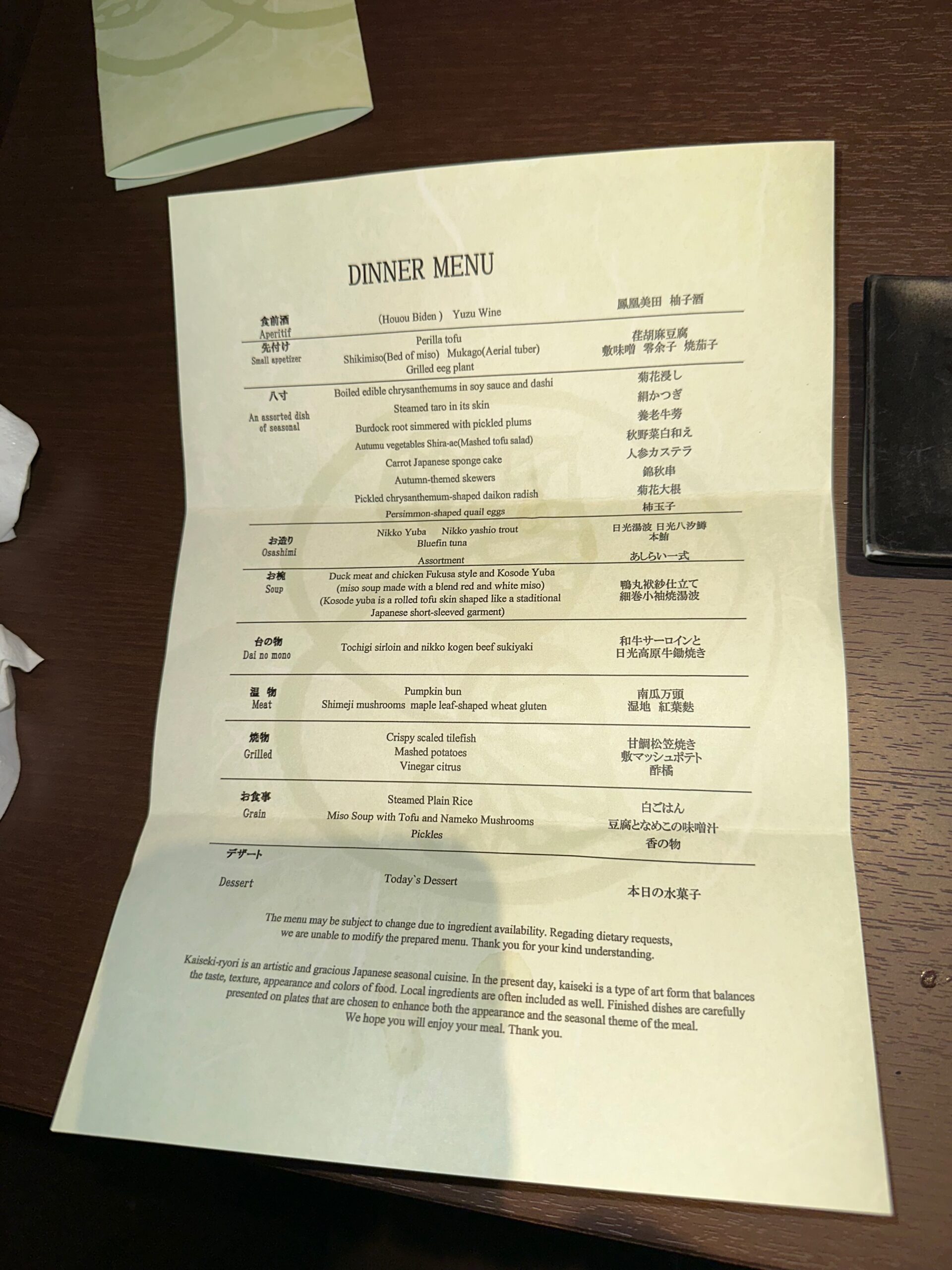
Our full kaiseki dinner menu
- Aperitif: Hōō Biden yuzu wine.
- Small appetizer: tofu with a bed of miso, mukago (small aerial yam tubers), and grilled eggplant.
- Seasonal assortment: edible chrysanthemums in soy sauce and dashi; taro steamed in its skin; burdock root simmered with pickled plums; autumn vegetables in a mashed-tofu dressing; carrot castella sponge cake; autumn-themed skewers; chrysanthemum-shaped pickled daikon; and persimmon-shaped quail eggs.
- Sashimi course: Nikko yuba, Nikko Yashio trout, and bluefin tuna with garnishes.
- Soup: duck and chicken prepared fukusa-style, with rolled kosode yuba in a blend of red and white miso.
- Sukiyaki: sirloin and Nikko Kogen beef.
- Warm course: a pumpkin bun with shimeji mushrooms and maple-leaf-shaped wheat gluten.
- Grilled course: tilefish with crisp scales, mashed potatoes, and citrus.
- Rice course: steamed rice, miso soup with tofu and nameko mushrooms, and pickles.
- Dessert: a small cheesecake.
A quiet evening in the onsen
After dinner, we headed to the hotel’s separate men’s and women’s onsen. The men’s bath was empty: I had the hot-water pool and sauna entirely to myself. Later, Inna and I met in the relaxation room for tea.
Before the night was over, I downloaded a sample of Hiro Arikawa’s The Travelling Cat Chronicles, which Inna had raved about. Its story follows Nana the cat and his owner, Satoru, on a road trip across Japan, exploring friendship, loyalty, and the bond between people and their animals.
Saturday, November 14, 2026
Leaving Nikko
The next morning began with the hotel’s packed breakfast and green tea for the journey. The breakfast was like a small rice bowl with fish inside: delicious, though not very filling. We boarded the 7:18 a.m. local from JR Nikko, choosing the earlier departure over the 7:52 train we had considered.
Busy trains and students on a Saturday
The trains on our journey from Nikko to Takayama were quite packed, with most seats taken. It reinforced how worthwhile it is to reserve seats ahead of time on trains that offer reservations. The local train from Nikko to Utsunomiya itself had unreserved seating.
On that local train, I noticed lots of teenagers in school uniforms. Since it was Saturday, I was surprised: I hadn’t expected to see so many students apparently heading to school.
Background: Japanese public schools generally have classes Monday through Friday, although some schools also hold Saturday classes. School sports and cultural clubs can meet on days off, too. The students we saw could have been traveling to classes, club activities, or a school event; their destination and reason for traveling weren’t confirmed. Japan National Tourism Organization: school schedules and clubs.
Food for the journey
I also noticed self-serve food shops in Japanese railway stations where passengers could choose snacks, bento boxes, and sushi to purchase for their journeys.
Background: Station bento meals are known as ekiben, a combination of the words for station and boxed meal, and often feature regional specialties. JNTO: local ekiben culture.
Wi-Fi was available on the trains we took, but frequent connection dropouts made using it hit-or-miss.
Cappuccinos at a chilly Utsunomiya Station
Utsunomiya Station felt unusually cold. During our connection, Inna and I stopped at Beck’s Coffee Shop inside the Shinkansen ticket gates and ordered a cappuccino each while waiting for our next train. They were ¥540 (approximately US$3.38) each, or ¥1,080 (approximately US$6.75) for the two of us.
Tickets, sandwiches, and pastries in Toyama
Collecting our Hida tickets at Toyama took a little figuring out: the JR West office was not easy to find. Inna found the office and collected the tickets from a machine, then a staff member checked them for us.
With the tickets sorted, we fitted in a quick lunch at Saint Marc Café at Toyama Station. We ordered a hot ham-and-cheese sandwich set for ¥980 (approximately US$6.13) and a hot BLT set for ¥1,030 (approximately US$6.44), each including a medium café latte. We also picked up two premium almond Choco Cro pastries for ¥680 (approximately US$4.25) for the pair. Lunch wasn’t bad, and the total of ¥2,690 (approximately US$16.81) for the two of us made it a fairly inexpensive stop between trains.
Was our itinerary covering too much ground?
By the time we were working through the transfers to Takayama, the journey felt hectic and tedious. Inna had put a lot of work into buying tickets and reserving our assigned seats. With the trains so full, that preparation was clearly worthwhile.
Even so, I began to question the pace: were we spending too much of our trip getting from place to place, and too little enjoying the places themselves? I appreciated all Inna had done to make the journey possible, but wondered whether fewer stops might have given us more time to enjoy each one.
Nikko to Takayama — November 14 train details
- We boarded the unreserved JR Nikko Line local at JR Nikko at 7:18 a.m. The timetable arrival at Utsunomiya was 8:06 a.m., giving a scheduled 60-minute connection before Yamabiko 208. JR Nikko is separate from Tobu-Nikko, where we arrived the day before.
- Booked JR East Tōhoku Shinkansen Yamabiko 208: Utsunomiya 9:06 a.m. → Ōmiya 9:34 a.m.; car 6, seats 10D (Inna) and 10E (Boris). Confirmation total for two adults: ¥7,220 (approximately US$45.12). The earlier local gave a scheduled 60-minute connection at Utsunomiya.
- Booked Hokuriku Shinkansen Hakutaka 557: Ōmiya 9:57 a.m. → Toyama 12:04 p.m.; car 9, seats 12A (Inna) and 12B (Boris). Confirmation total for two adults: ¥24,880 (approximately US$155.50). The Ōmiya connection is 23 minutes.
- Booked JR limited express Hida 14: Toyama 1:08 p.m. → Takayama 2:39 p.m.; ordinary reserved, non-smoking car 8, seats 8A and 8B. Total ¥7,240 (approximately US$45.25) for two adults, including the basic fare. The Toyama connection is 64 minutes.
- Our two Shinkansen reservations used each traveler’s designated Suica / e-ticket arrangement. At Toyama, Inna collected the Hida paper tickets from a ticket machine, and a JR West staff member checked them for us.
US-dollar equivalents are approximate, using the trip’s rounded reference rate of ¥160 to US$1; they are not actual card or ATM exchange rates.