A hot bath with a forest view was one of the pleasures of Hirayu Onsen. Inna and I spent two nights at Miyama Ouan, where the beds were wonderfully comfortable, the room was quiet, and a soak was always waiting. The stay had its frustrations, too: awkward dinner times, a disappointing lounge, and a room at the farthest end of the complex.
Beyond the baths, we took two packed gondolas into the mountains at Shinhotaka Ropeway, where the temperature hovered just above freezing and rain cut our short hike even shorter.
November 16–18 records our experiences, including our early departure for Takayama. All times are JST.
Monday, November 16, 2026
The bus from Takayama to Hirayu
We left Takayama on the 1:40 p.m. bus and reached Hirayu about an hour later.
The last leg was easy. We called Miyama Ouan, and the hotel picked us up within about five minutes.
Checking in at Miyama Ouan
At Miyama Ouan, we showed our passports and checked in. The hotel’s floor numbering was confusing: the floor we understood to be the third was labeled as the second in the elevator, and there seemed to be two second floors. It took a little getting used to!
The room had a puzzle of its own: a cupboard with an unfamiliar lock. We called someone to help open it, unpacked some of our bags, and turned our attention to something simpler—a bath.
Comfortable beds, a forest view, and a long walk to the lobby
After our compact room in Takayama, having a separate bedroom and living room was a welcome change. The two Western-style twin beds were very comfortable compared with those at other hotels. The living room had a TV, fridge, and tea-making set, with a large window looking straight out onto the forest.
The toilet had its own room and its own slippers. A separate bathing room held a traditional Japanese shower and our private onsen bath. The bath stayed hot and had a forest view, though it was really meant for one person.
It was very quiet, as all our hotel rooms in Japan had been so far. My complaint was the location: ours was the farthest room in the complex. I would have preferred one closer to the lobby.
A relaxing bath at Hirayukan
We had heard good things about the baths at nearby Yumeguri no Yado Hirayukan, so we went to try them. A group of motorcycle travelers was checking in as we arrived, with perhaps six to eight bikes loaded with saddlebags and extra luggage. Most looked like Honda Africa Twins. The riders appeared to be mostly Western men and women in their thirties to fifties. With cold weather closing in and rain forecast, I was surprised to see them still touring the Japanese Alps so late in the season.
The soak at Hirayukan was lovely, and I tried the electric massage chair as well. After all the walking and travel, both were welcome. We then returned to Miyama Ouan.
By evening, Hirayu was feeling really cold. The forecast promised rain as well—something to keep in mind for our mountain outing.
The forecast we were planning around
It had started to feel really cold around Miyama Ouan. The forecast for Hirayu listed a high of about 9°C (48°F) and a low of 3°C (37°F) for November 16. November 17 was forecast to reach around 12°C (54°F), falling to 6°C (43°F), with a 90% chance of precipitation and some light rain. These were forecasts for the area, rather than temperatures measured at our hotel.
A lounge that fell short
The extra lounge at Miyama Ouan cost ¥1,100 per person (approximately US$6.88), and we decided to give it a try. We were disappointed. The coffee machine was fine but nothing special, and the whisky and soda, beer, and Cabernet Sauvignon did not make it feel worth the money.
There were complimentary ice cream bars, warm sake, and other Japanese snacks elsewhere in the hotel, too. The extras were nice to have, but their quality disappointed us as well.
Dinner at Miyama Ouan
Dinner came with a choice I did not particularly like: 5:30 p.m. or 8:00 p.m. I would have preferred 7:00, but we chose the later seating.
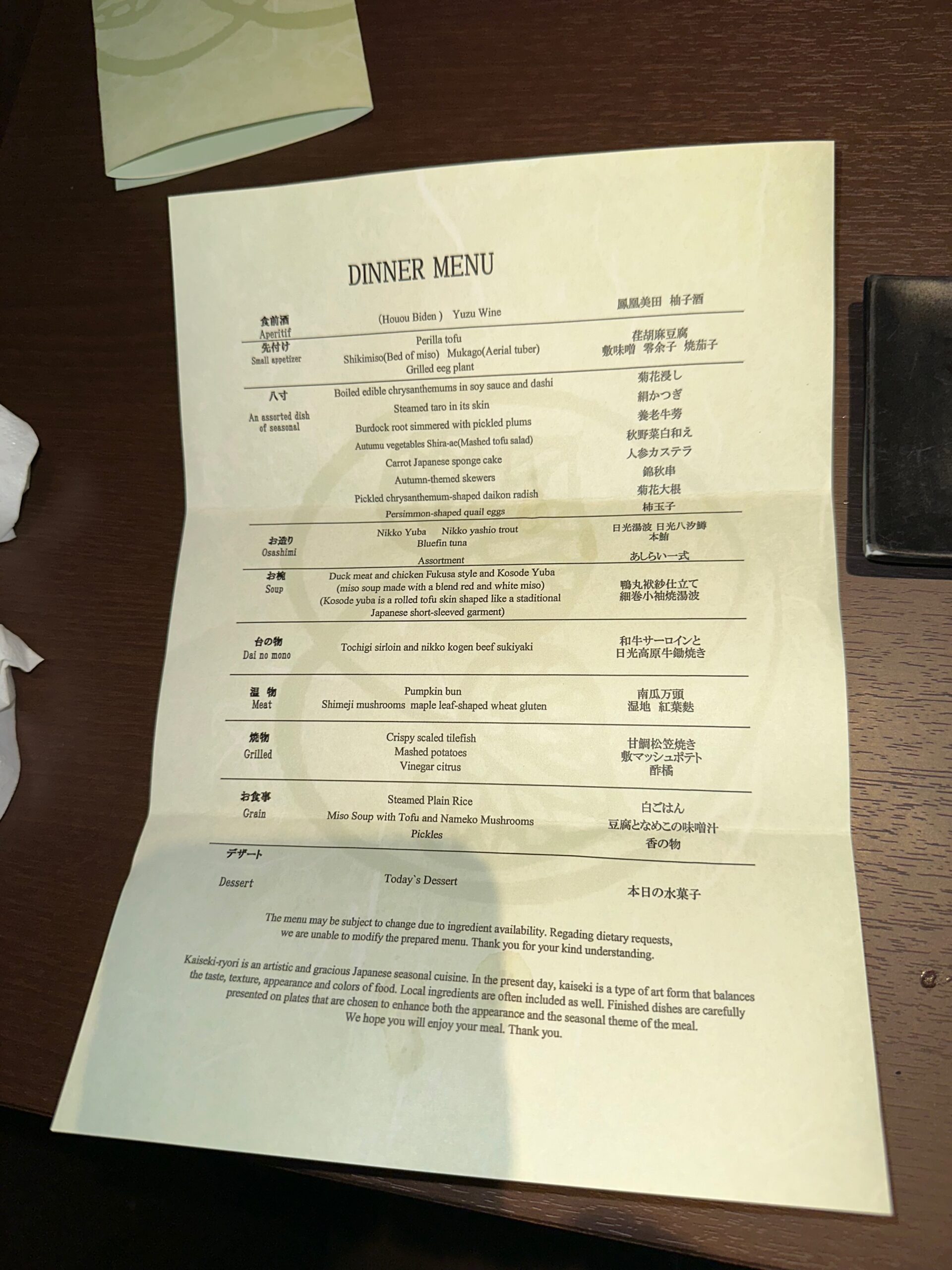
At 8:00 p.m., we sat down to a multi-course dinner at Miyama Ouan. Hida beef appeared in two forms: an individual sukiyaki-style hotpot and cuts for grilling. We also chose carbonara-style savory egg custard, followed later by rice with Hida beef miso and red miso soup.
Tuesday, November 17, 2026
An early start and Japanese breakfast
I was up at 6:45 a.m. to shower and shave before our 7:30 breakfast. At the arranged time, we took the elevator to the second floor of Miyama Ouan.
Breakfast brought grilled fish, rolled omelet, vegetables, pickles, tea, and juice, with another dish warming on a large leaf over a tabletop grill. There was plenty of variety within the Japanese breakfast, but I would have liked a Western-style option for mornings when I wanted a break from Japanese food.
The morning bus to Shinhotaka Ropeway
Before setting out, we asked the staff to check the Shinhotaka Ropeway webcam. The advice was clear: visibility looked good that morning, but would worsen in the afternoon. This was our best day to go, and earlier was better.
We took the hotel shuttle at 9:10 a.m., then caught the 9:40 a.m. bus to Shinhotaka Ropeway. We arrived around 10:10 a.m. and quickly joined the line to exchange our tickets for ropeway boarding passes.
Two crowded gondolas into the mountains
Reaching the upper station took two gondolas, with a walk between them. The lower one left on the hour and half hour; the second ran at quarter past and quarter to. Both were packed. The upper gondola had two floors and seemed able to carry even more people.
Below, it had been cloudy and a little cold. Up top, it was just above freezing. We took lots of photos, then followed a pleasant loop to the Mt. Nishihotakadake Viewpoint, with a hiking trail continuing beyond it.
We went a little farther along the trail before rain began to fall. With mud underfoot as well, we turned around and headed inside for lunch.
Lunch out of the rain
We had shrimp-and-avocado sandwiches, tea, cappuccinos, and a slice of roll cake for lunch. It was not bad, and the sandwich was fresh. The total for the two of us was ¥4,140 (approximately US$26).
Too late for the autumn colors
Our biggest disappointment at Shinhotaka Ropeway was the timing. Inna and I had been looking forward to slopes filled with leaves in every color of the rainbow, but we had missed the season here. Takayama had still been spectacular; up in these mountains, we were too late.
Inna also felt that the views we had seen in the Dolomites were much more impressive than those from the upper ropeway station. I do not think we would return anytime soon, unless we could time the visit to catch the autumn colors at their best.
For anyone planning around the leaves, the ropeway’s official seasonal guide places the usual peak around mid-October. Our November visit was well past that window.
Green tea and a snack tasting back in our room
After returning from the ropeway, we headed to our room with the Japanese snacks we had just bought at Alps Kaidō Hirayu at the Hirayu bus terminal. Inna brewed green tea, and we enjoyed a few cups while trying our purchases.
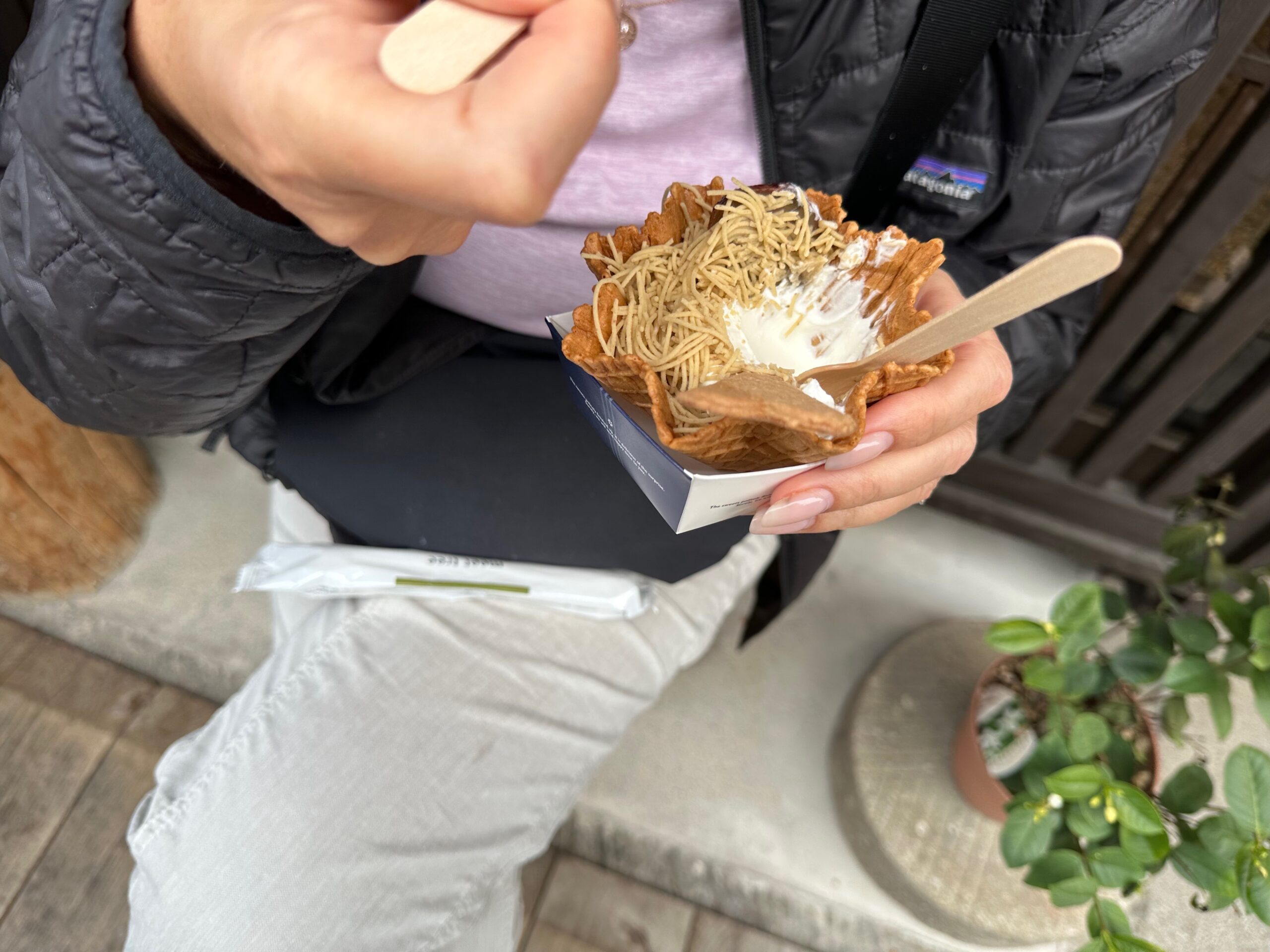
The wasabi chocolate, ¥540 (approximately US$3.38), had a very unusual taste—strange, really. We did not like the Hida cheesecake, ¥600 (approximately US$3.75), but the Milk Art milk-pudding caramelized baum cake, ¥700 (approximately US$4.38), was not bad. We had also bought Milk Art langue-de-chat cookies for ¥1,190 (approximately US$7.44). The shopping came to ¥3,035 (approximately US$18.97), including the bag.
An afternoon in the indoor and outdoor onsen
After tea and snacks, we headed to the public onsen at Miyama Ouan. The men’s and women’s baths were separate. I enjoyed spending time in both the indoor and outdoor baths, and Inna enjoyed hers as well.
Dinner: learning our way around shabu-shabu
Dinner back at Miyama Ouan brought another chance to try Hida beef, this time as shabu-shabu, with mushrooms, vegetables, tofu, and kudzu-starch noodles. We were still beginners at cooking the meat this way, so we may not have got everything quite right. The meat was not bad.
There was plenty around the hot pot: lotus-root tofu, pumpkin with white sesame-tofu dressing, and beef simmered with ginger, along with Hida beef and salmon sushi, assorted sashimi, and simmered alfonsino. For our side dish, we chose the carbonara-style savory egg custard.
Dinner was OK overall, but the noodles felt unnecessary and were a bit tasteless. The menu included udon as well as the noodles accompanying the shabu-shabu. Dessert was chiffon cake with whipped cream, persimmon, and kiwi fruit.
A place to slow down
Overall, Miyama Ouan was not bad at all. The onsen were the main attraction, and it was a great place to relax. Compared with Takayama, though, there was much less variety in shops and activities. For us, this was a place to slow down and soak, rather than fill the day with browsing and sightseeing.
November 18: onward travel plans
Wednesday, November 18, 2026
An early checkout and a surprise departure
We woke at 6:30 a.m., as planned. I showered and dressed, and we skipped the Japanese breakfast at Miyama Ouan. We were ready for something different in Takayama. After checking out, we set off with our luggage at 7:05 a.m. The hotel offered no morning shuttle, which was disappointing, but the seven-minute walk to the bus terminal was easy and pleasant, with very little traffic.
The ticket office was closed; its opening time was 8:15 a.m. A friendly Japanese woman who was also going to Takayama explained that we could buy tickets from the driver. The bus arrived at 7:20 a.m., we loaded our luggage and boarded, and it pulled away at 7:30 a.m. That surprised us: the schedule we had showed 7:45 a.m.
We reached Takayama at 8:20 a.m. and stored our luggage in a large ¥900 locker (approximately US$5.63). Hot sandwiches and cappuccinos at Coffee Don, followed by snacks at the morning market, gave us the change of breakfast we had wanted. Our return morning in Takayama turned into a pleasant last look around before the 11:35 a.m. train to Nagoya and our onward Shinkansen to Kyoto.
Our booked train details and fares
- Booked JR Central limited express Hida 8: Takayama 11:35 a.m. → Nagoya 2:04 p.m.; ordinary reserved, non-smoking car 2, seats 8A and 8B. Total ¥12,280 (approximately US$76.75) for two adults, including basic fare. Carry the collected paper tickets.
- Booked JR Central Tōkaidō Shinkansen Nozomi 259: Nagoya 2:41 p.m. → Kyoto 3:15 p.m.; car 4, seats 5D (Inna) and 5E (Boris). Total ¥11,420 (approximately US$71.38) for two adults, reserved through SmartEX.
- Transfer buffer at Nagoya: 37 minutes. Follow the Shinkansen transfer-gate instructions for the actual paper ticket and each traveler’s designated Suica, and collect the seat-information slip. From Kyoto Station, our plan was to continue to Ace Hotel Kyoto by local transport or taxi; that final transfer is not separately booked.
What our luggage locker actually cost
Our large locker cost ¥900 (approximately US$5.63), paid with nine ¥100 coins. This was our actual November 18 price; the ¥700 large-locker figure we had found in an earlier visitor guide did not match the locker we used. Station and luggage-storage guide.
Details to add later
- Any later evening activities beyond dinner.
- Photographs and practical notes on the bus and hotel transfers.
US-dollar equivalents are approximate, using the trip’s rounded reference rate of ¥160 to US$1; they are not actual card or ATM exchange rates.