We arrived in Shirakawa-go with umbrellas out and autumn colors everywhere. Morning mist hung over the thatched farmhouses, and the rain gave us a good excuse to linger over cake, coffee, and a book. Inna and I had come from Takayama for the day; by early afternoon, we had also enjoyed an excellent Hida beef lunch and made a dash for an earlier bus home.
Sunday, November 15, 2026
An early arrival, umbrellas at the ready
The 7:20 a.m. bus from Takayama brought us to Shirakawa-go at 8:10. We stepped into light rain, opened our umbrellas, and set off to explore.
Autumn colors above Ogimachi
We began with the Ogimachi Castle Observation Deck, about fifteen minutes away on foot. The path started level, then climbed uphill through foliage in green, red, orange, yellow, and every shade between. We kept stopping for photographs on the way up—and again on the way down. A little morning fog added to the atmosphere before lifting.
There was little castle left to see, but the village view from above was impressive. After taking it in, we headed downhill to Wada House for a closer look at one of those thatched homes.
Ogimachi Castle: the fortress behind the viewpoint
Long before this hill became a photography stop, it helped guard the Shō River valley. In the fifteenth and sixteenth centuries, the Uchigashima family controlled the area and maintained a chain of hilltop defenses. Ogimachi Castle was one of them, supervised by the Yamashita family.
The site stood roughly 60 meters above the village, with steep drops on three sides and views over the river and valley road. Its defenses are thought to have relied on earthworks and a dry moat. What survives is a castle site rather than an intact tower or palace; the overgrown moat is a reminder of its former role.
An earthquake in 1585 apparently destroyed the Uchigashima’s main stronghold at Kaerigumo Castle. Ogimachi’s last lord, Yamashita Ujikatsu, subsequently left the area, and the fort fell out of use. Whether Ogimachi Castle ever saw battle is unknown. Japan Tourism Agency: Ogimachi Castle history.
Wada House
Wada House gave us a look inside a gasshō-zukuri farmhouse. We spent about fifteen minutes there before I was ready to move on. The village views and autumn foliage had more of a hold on my attention.
Wada House: family history and life beneath the thatch
Built in the late Edo period, Wada House is the largest traditional gasshō-style farmhouse in Shirakawa-go and a nationally designated Important Cultural Property. The family held the hereditary post of village headman and supervised a checkpoint controlling travel and trade. Saltpeter, a gunpowder ingredient, helped make their fortune; silk production became another important business in the latter half of the nineteenth century.
The house’s entrances reveal the family’s standing. One served residents, while large doors leading directly to tatami rooms welcomed officials and other distinguished guests. Plastered earthen walls offered better fire resistance than bare wood. On the north side, a garden—unusual in this snowy region—is sheltered by stone walls and trees planted as windbreaks. Japan Tourism Agency: the Wada family and its house.
Inside, a traditional irori hearth forms the center of the first floor, alongside displays of household utensils and a Buddhist family altar. The attic reveals the great roof framework, secured with straw rope and flexible wooden bindings. Tools and displays explain the work of maintaining the thatch. Parts of the building remain a private residence, so the visitor areas do not represent the entire house. Official guide to the interior and roof construction.
The Shirakawa-go Tourist Association’s Wada House page has visitor information. These details are historical background, rather than a claim that we examined every feature during our short visit.
Rain outside, cake and a book inside
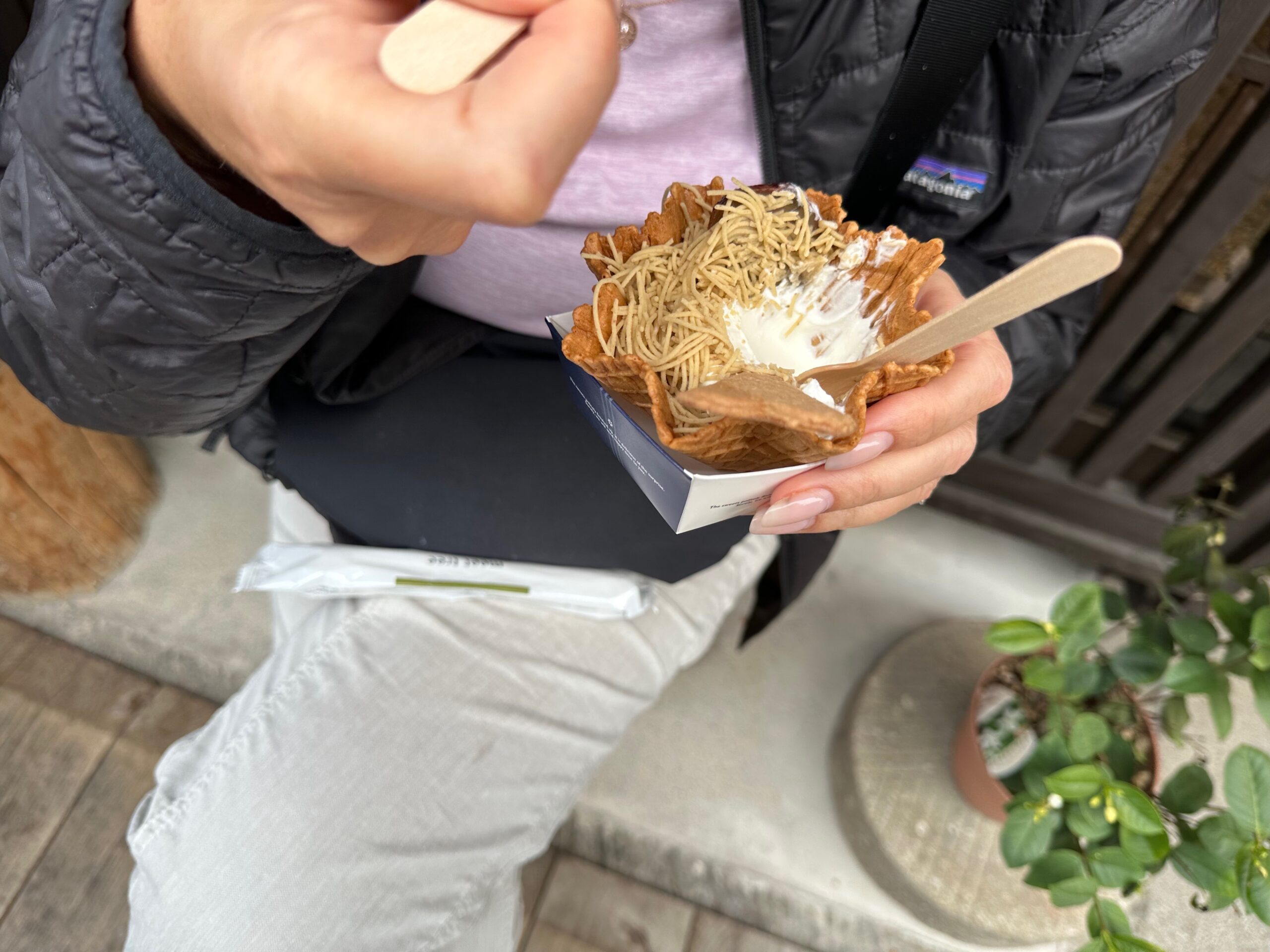
At Hanamizuki Shirakawa, ordering began at a machine that looked more like an ATM than a café counter. We chose our food and drinks, then handed the printed coupons to the staff: one matcha, one café latte, strawberry cake, and matcha cake. The cakes and drinks were excellent.
With rain still falling, we were in no hurry to leave. I continued reading The Traveling Cat Chronicles, and we eventually ordered two more café lattes. It was a slower interlude between walks around the village.
The Three Houses and children in traditional dress
Back outside, we saw the famous Three Houses and visited Shirakawa Hachiman Shrine. Around 11:00 a.m., a Shichi-Go-San celebration was taking place. Japanese national flags were displayed, and many young children wore traditional Japanese clothing.
Why were the children dressed up?
Background: Shichi-Go-San is the traditional children’s blessing celebration associated with November 15. As explained by Web Japan, families take children aged three, five, and seven to shrines to pray for their healthy growth. Children often wear kimono or other formal traditional clothing.
Hida beef and a garden view at Magoemon
Lunch at Gassho Teahouse Magoemon came with a change of seating: after about fifteen minutes of waiting, we sat on tatami mats, usually cross-legged, rather than on chairs. The garden views were amazing.
I chose the traditional Hida beef shoulder loin set, prepared sukiyaki-style; Inna ordered the Hida beef miso set. We cooked the meat ourselves, flipping it after four minutes. Everything was impeccably prepared, and lunch was wonderful. Inna found sitting on the floor uncomfortable, though; she would have preferred a table and chairs.
A dash for the earlier bus
After lunch, we decided to see whether we could get back to Takayama earlier than planned. At the Shirakawa-go Bus Terminal, there was a 1:15 p.m. departure to aim for. We hurried to exchange our tickets, only to find that we could not. Instead, we bought new ones—and made it onto the bus.
We left at 1:15 p.m. and reached Takayama at 2:10, well ahead of our original evening return. The morning had given us misty village views, extraordinary leaves, time to read, and a memorable lunch; now we had more of the afternoon to spend in Takayama.
Original bus bookings and fares — November 15
These were the original booking details. We returned on newly purchased tickets for the 1:15 p.m. departure instead; the new ticket price has not been recorded. The amounts below cover only the original bookings.
- Outbound operator: Dolphin Traffic Co., Ltd., on the Takayama–Shirakawa-go/Kanazawa line. The bus departed Takayama Nōhi Bus Center at 7:20 a.m. and arrived at Shirakawa-go (Ogimachi) at 8:10 a.m.
- Original return booking (not used): Nōhi Bus Co., Ltd. Scheduled departure from Shirakawa-go (Ogimachi) at 5:25 p.m.; scheduled arrival at Takayama Nōhi Bus Center at 6:15 p.m.
- Both original bookings were for two adults in car 01, seats 2A and 2B. Each direction cost ¥5,600 (approximately US$35.00) for both travelers; the recorded round-trip total is ¥11,200 (approximately US$70.00).
US-dollar equivalents are approximate, using the trip’s rounded reference rate of ¥160 to US$1; they are not actual card or ATM exchange rates.