After ten miles of near-constant turns, I was glad to get out of the van. At Ekōin in Koyasan, we discovered that our room at a Buddhist temple came with its own garden and onsen.
One last breakfast in Kyoto
We woke at 6:45 a.m. at Ace Hotel Kyoto. I showered, shaved and dressed, and we packed before breakfast on the third floor. I ordered the Californian and Inna had Eggs Benedict. We were a little sad to leave Kyoto after such a good breakfast. I’d barely had a chance to play the Epiphone in our room.
The road up to Koyasan
Our driver got in touch, and we met him downstairs at 8:45 a.m. After checkout, we climbed into a van that reminded me of a fancier Toyota Sienna, with reclining rear seats and an adjustable footrest. An accident slowed traffic, and we made a quick restroom stop.
The last ten miles were the part I remembered. One bend led straight into the next, and I think I got a little carsick, which almost never happens to me. We reached Ekōin Temple around 11:40 a.m. and checked in right away.
A room at the temple
Room 502 looked new, and the woodwork alone was worth a closer look. We had a separate bedroom with a king-size bed, a dining room, a garden, and a private onsen in the bathroom. I hadn’t expected that kind of comfort at a Buddhist temple in the mountains, far from Japan’s big cities.
A Brief Overview of Ekōin
Ekōin is a Buddhist temple and shukubō, or temple lodging, in Koyasan. The temple traces its history to Kūkai, the founder of Japanese Shingon Buddhism. Guests can learn about temple life through practices such as morning services and meditation. Ekōin’s temple history.
Koyasan felt much colder than Nara or Kyoto, with temperatures hovering around freezing. We saw several large tour groups as we walked around. Most were Japanese, and we also saw quite a few German groups.
Lunch at Tempu Terrace
After a walk around Koyasan, we stopped for lunch at Tempu Terrace, near Ekōin, where we were staying for the night. We were seated upstairs and looked over the English menu. Inna chose the lunch special with soup, salad, tea, pasta, roast beef, and the chef’s choice of dessert. I went for the roast beef special with salad and rice bread. Inna also ordered a drink with a Koyasan temple emblem in the foam.
The roast beef was fresh and delicious. I especially liked the rice bread, and my lunch stretched to a taste of Inna’s pasta and a share of her dessert. Lunch came to ¥7,660 (about US$47.88) for the two of us, which felt reasonable for everything we had.
Fall leaves, Totoro, and Kongōbu-ji
We kept stopping after lunch, sometimes for a photo of the fall leaves and sometimes for a shop. A little store selling Studio Ghibli’s Totoro merchandise sent us on our way with a few souvenirs. From there we made our way to Kongōbu-ji, the head temple of Koyasan Shingon Buddhism.
A Brief Overview of Kongōbu-ji
The head temple of Koyasan Shingon Buddhism stands within the mountain complex Kūkai established in 816. The current main building was rebuilt in 1863, and two temples on the site were combined under the Kongōbu-ji name in 1869. Highlights include painted sliding doors and the Banryūtei rock garden. Kongōbu-ji’s precinct guide.
How did Buddhism take root in Japan?
Buddhism reached Japan through exchanges with the Korean peninsula and continental Asia. Its formal introduction is traditionally dated to 538 or 552, when the kingdom of Baekje sent Buddhist gifts to the Japanese court. In the eighth century, Emperor Shōmu sponsored a network of provincial temples centered on Tōdai-ji in Nara, where Buddhist rites were performed for the protection of the country. The Metropolitan Museum of Art · Tōdai-ji’s history of the Nara period
Who was Kūkai, and why did he go to China?
Kūkai (774–835), later known as Kōbō Daishi, was a Japanese Buddhist monk. He traveled to Tang China as a student monk on an official mission in 804. In Chang’an, today’s Xi’an and then a major center of Buddhist learning, he studied with the esoteric Buddhist master Huiguo at Qinglong Monastery. Koyasan Shingon’s introduction to Kūkai
What teachings did Kūkai bring back from China?
Huiguo initiated Kūkai into traditions associated with the Womb Realm and Diamond Realm mandalas. These diagrams of the Buddhist cosmos guide practices involving mantras, ritual hand gestures called mudras, and visualization. Kūkai returned to Japan in 806 with texts, mandalas, and ritual implements. Stanford Encyclopedia of Philosophy
What makes Kūkai’s Shingon tradition distinctive?
Shingon centers on Dainichi Nyorai, the cosmic Buddha. In its practice of the Three Mysteries, practitioners bring body, speech, and mind together through gestures, mantras, and meditation. A central teaching is that Buddhahood can be realized in this very body. In 816 Emperor Saga granted Kūkai the use of Koyasan, where he established a mountain center for practice and training. Kongōbu-ji serves as the head temple of Koyasan Shingon today. Koyasan Shingon Buddhism · Koyasan Shukubo Association
Why do pilgrims and travelers come to Koyasan?
Pilgrims pay their respects at Kūkai’s mausoleum in Okunoin, where tradition holds that he remains in meditation. Visitors can also stay overnight at a temple, explore the ritual complex at Danjō Garan, and see Kongōbu-ji’s painted sliding doors and Banryūtei rock garden. It’s a mountain community where people still practice the traditions they come to learn about. Koyasan forms part of UNESCO’s Sacred Sites and Pilgrimage Routes in the Kii Mountain Range. Okunoin visitor guide · UNESCO World Heritage listing
A Brief Overview of Danjō Garan
This is one of Koyasan’s principal areas for monastic training and ritual. The Kondō is the main ceremonial hall, and the tall Konpon Daitō pagoda houses Buddhist figures laid out as a three-dimensional mandala. Koyasan’s guide to the precinct.
A Brief Overview of Okunoin
A pilgrimage path lined with graves and memorials leads to Kūkai’s mausoleum. In Shingon tradition, Kūkai remains there in meditation. The Lantern Hall stands just before the mausoleum and forms part of the active devotional precinct. JNTO’s Okunoin guide.
Dinner on tatami at Ekōin
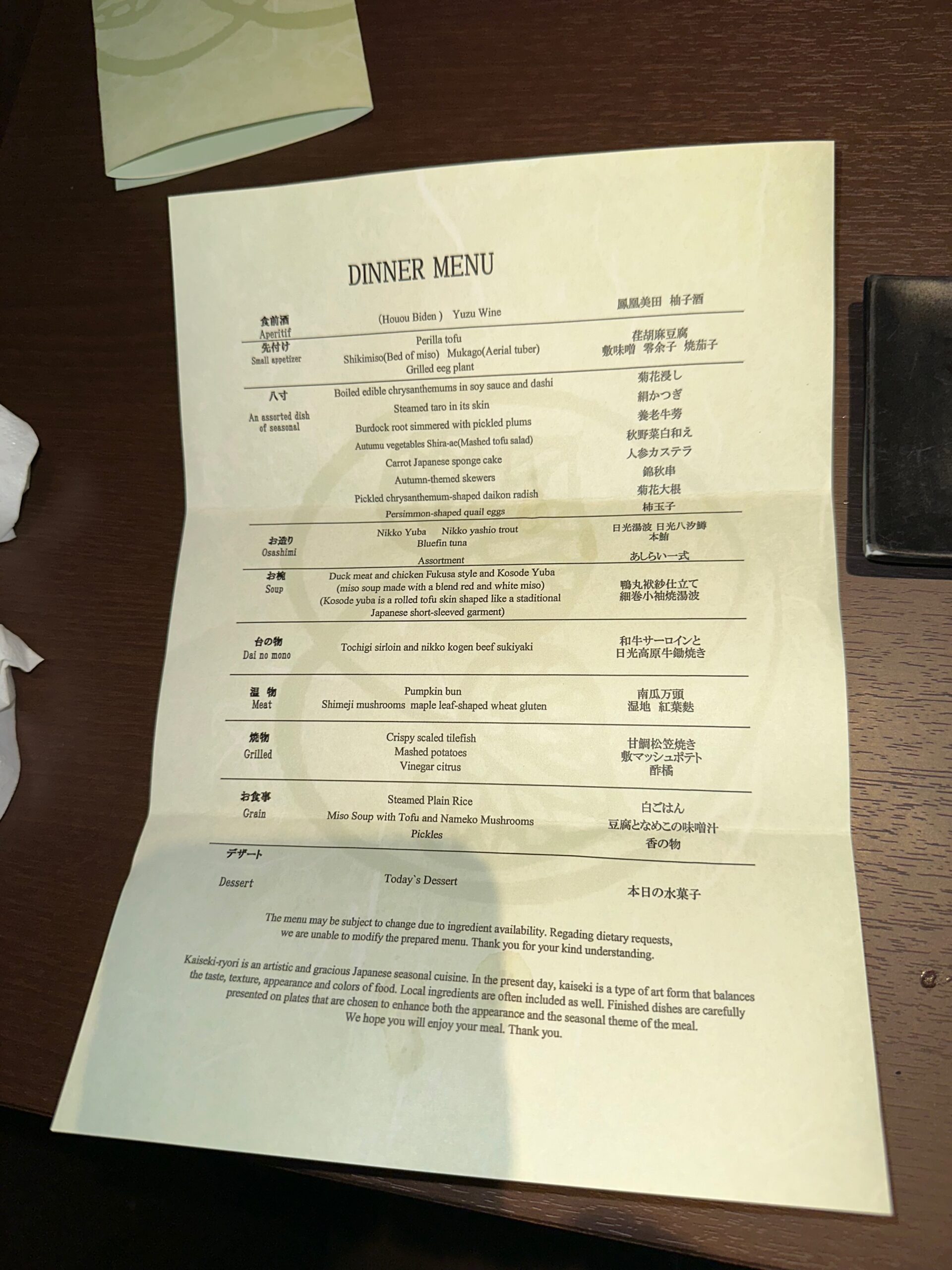
At 5:45 p.m. we sat on cushions on the tatami in a separate dining room at Ekōin. Dinner was shōjin ryōri, the vegetarian cooking served at Buddhist temples. The menu ranged from sesame tofu and miso-glazed eggplant to a mushroom hot pot. Even the sashimi-style dish was vegetarian, made with seaweed konjac and yuba (tofu skin).
I was surprised by how good the meal was. There were only a few things I didn’t care for. We hurried toward the end so Inna would be on time for her night tour of the Okunoin cemetery.
US-dollar equivalents use our trip’s reference rate of ¥160 to US$1.
Links
Temples and pilgrimage
- Ekōin Temple lodging
- Kongōbu-ji and the Koyasan temple precincts
- Okunoin
- UNESCO World Heritage listing